High Roller PayID Casinos in Australia
The threshold that changes how the cashier behaves The first time I helped a player walk through an A$25,000 PayID deposit, the friction was almost theatrical — three banking app…

After the 11 June 2024 crypto wagering ban, is PayID the only real choice for Aussies? Volatility, privacy and offshore reality compared
 Available in AU
The crypto-versus-PayID comparison was a live debate in 2022, a marginal debate in 2023, and a settled question from June 2024 onward. The legal framing changed completely when the Australian government’s ban on credit cards and digital currencies for online wagering took effect on 11 June 2024. Penalties for licensed operators accepting prohibited methods reach A$247,500 per breach. The conversation about which method is “better” for Australian players has, since that date, been a conversation about which method you can use at all.
That said, the picture isn’t binary. Offshore operators continue to accept crypto from Australian players because the ban targets licensed Australian wagering providers, not players. Players using crypto at offshore platforms aren’t breaking laws written for operators — but they’re choosing to operate outside the regulatory framework that protects everyone else. This article walks through the legal context, the offshore reality, the speed and volatility differences, and why PayID has effectively become the default banking rail for any Australian player who values legal clarity alongside transactional efficiency.
The legislation prohibits Australian-licensed online wagering operators from accepting payments via credit card or digital currency for any wagering activity. The intent, in the words of the social services minister at the time the ban took effect, was straightforward: “Our government takes seriously our responsibility to prevent and reduce harm from online wagering. Our ban on credit cards will help with this goal. You can’t use your credit card to place a bet for land-based gambling. Now the same rules apply for online gambling.”

The same enforcement applies to digital currencies under the same legislative framework. ACMA reported a very high level of compliance from licensed operators in the months following the ban, with all 50-plus licensed wagering operators removing credit card and crypto references from their terms by mid-2025. The licensed AU wagering sector has effectively closed both rails.
The offshore segment is structurally separate. Offshore casinos aren’t ACMA-licensed in the first place — they operate under Curacao, Anjouan, or similar licensing regimes and don’t fall within the Interactive Gambling Act’s compliance obligations the same way licensed wagering operators do. ACMA blocks their domains where it identifies them, but it doesn’t fine them directly for accepting crypto, because they were never permitted to serve the Australian market under AU law to begin with.
Most offshore casinos still accept Bitcoin, Ethereum, Tether, and increasingly USDC. The cashier offers crypto alongside PayID, Neosurf, and (where available) wire transfer. From the player’s point of view, you can fund the account either way. But the player and the operator are operating in completely different legal positions: the operator is offshore and outside AU jurisdiction; the player is in Australia, transacting from an Australian bank account or crypto wallet to an offshore destination.
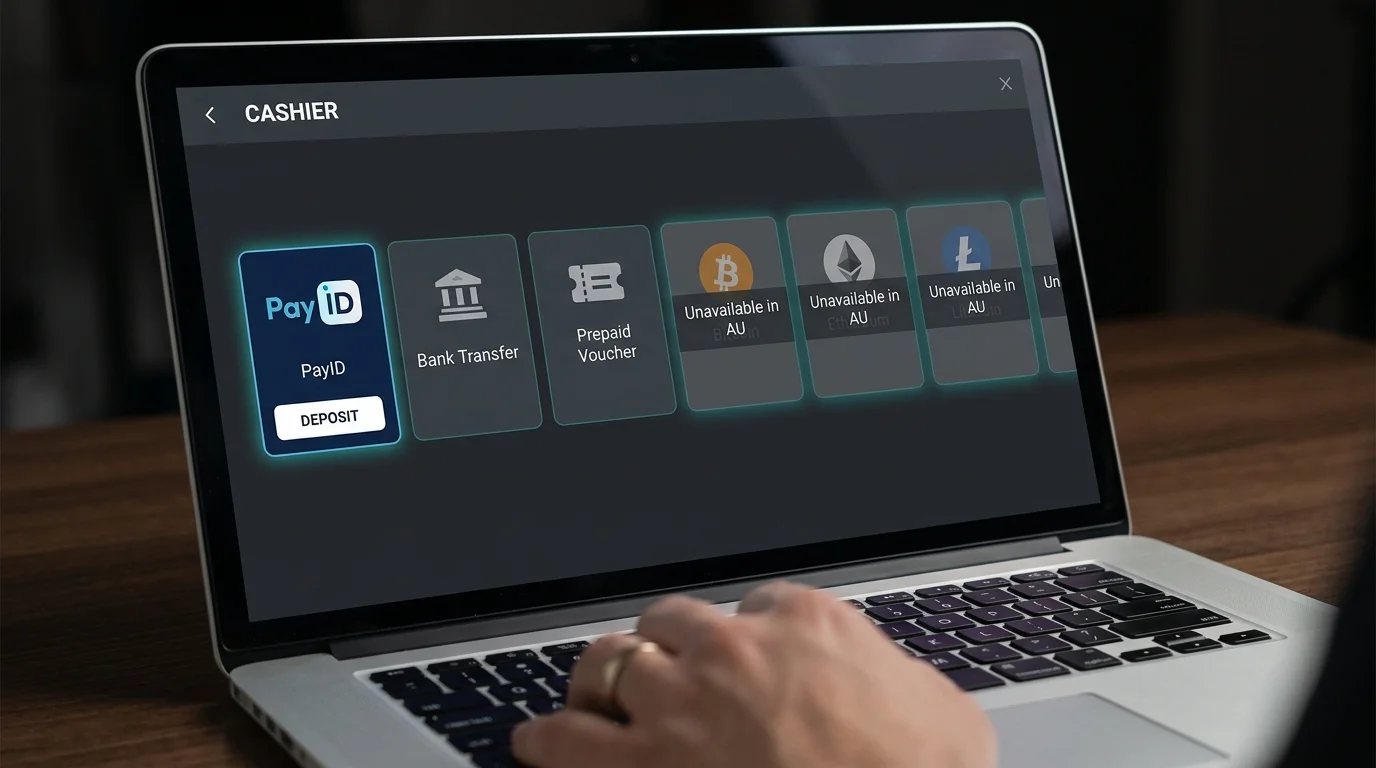
The practical risk for the player using crypto isn’t a fine — it’s the absence of recourse. PayID transfers fall within the NPP framework, which is regulated by the RBA and APRA. NPP transactions can be disputed through your bank, and the Australian Financial Complaints Authority (AFCA) extended its jurisdiction in March 2026 to cover certain scam-receiver scenarios on the NPP rail. Crypto transactions, once on-chain, are non-reversible. There’s no AFCA equivalent for Bitcoin disputes. A wrong-address transfer or a fraudulent operator absorbing your deposit is, with crypto, simply gone.
PayID itself is fully legal infrastructure operated by Australian Payments Plus on the New Payments Platform, regulated by the Reserve Bank of Australia. The rail processed about 1.99 trillion AUD in 2024 across roughly 1.6 billion transactions, with year-on-year growth above 20%. It’s mainstream financial infrastructure used for everything from rent payments to small business invoicing.

The legal complication is on the casino side, not the rail side. PayID is a payment method; the operator receiving the PayID is the entity whose legal status matters. An offshore operator accepting PayID from an Australian player is operating outside the Interactive Gambling Act’s permitted scope — that’s the operator’s exposure, not yours. The PayID rail itself is doing exactly what it was designed to do: moving money cleanly between bank accounts on the NPP infrastructure.
The practical implication is that PayID transactions land in your bank’s record-keeping system the same way any other transfer does, with full transaction logs available if you need to dispute or trace anything. The transparency is the protection.
PayID deposits to an offshore casino typically clear in under 60 seconds, with the bottleneck being the operator’s cashier confirmation rather than the rail itself. Withdrawals via PayID land in your bank account within 24 hours after operator approval, with the actual NPP transfer taking seconds and the operator’s batch processing accounting for most of the elapsed time.

Crypto deposits depend on the network. Bitcoin transactions require typically 3 to 6 confirmations on-chain before the casino credits the deposit, which can take 30 minutes during low congestion and 2 hours during high. Ethereum and Tether on the Ethereum network typically clear faster — 5 to 15 minutes — and stablecoins on lower-fee chains (Tron, Solana, Polygon) often clear in 1 to 3 minutes. The fastest crypto experience can beat PayID by a small margin on a quiet network day; the slowest can take longer than waiting for the operator’s overnight withdrawal batch.
Withdrawals follow the same pattern in reverse. Crypto withdrawals from the operator clear once they’re broadcast on-chain, then take their network’s standard confirmation time to reach your wallet. PayID withdrawals are simpler in their variance — the only timing is the operator’s processing window.
This is the structural risk that’s often understated. A player who deposits A$1,000 worth of Bitcoin at the operator’s exchange rate, plays for an hour, and requests withdrawal of A$1,500 worth of Bitcoin is exposed to Bitcoin’s exchange rate movements at the moment of withdrawal. If BTC drops 5% during the session, the AUD value of the cashout is materially less than expected, even before considering the wins themselves.

The flip side: if BTC rises during the session, the cashout gains value beyond what the player won at the table. This is a separate risk from the gambling outcome itself, and it compounds with it. A player who wins A$200 on the casino game but loses A$80 to currency depreciation between deposit and withdrawal ends up with a net A$120 win — a different outcome than the game scoreboard suggests.
Stablecoins like USDT and USDC reduce this risk but don’t eliminate it — they peg to USD, not AUD, so the AUD-USD exchange rate at the moment of conversion to fiat is still a variable. PayID has zero exposure to either kind of FX risk because the transaction is denominated in AUD end-to-end.
Crypto offers stronger privacy on the deposit step than PayID. A Bitcoin wallet address isn’t directly tied to your name in any centralised registry. Sending BTC from an exchange-hosted wallet leaves traces through the exchange’s KYC records, but sending from a self-custodied wallet that you’ve never KYC’d is functionally pseudonymous.
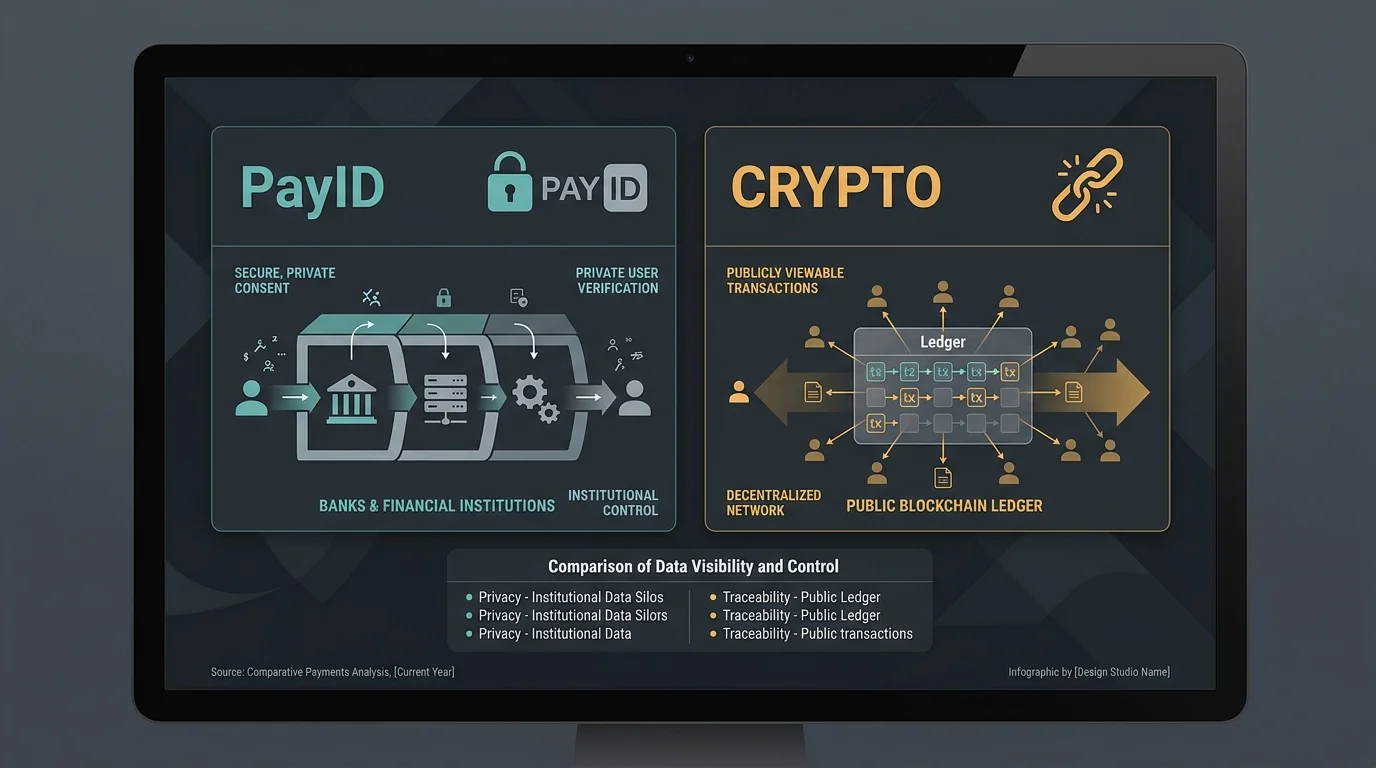
The flip side: every crypto transaction is permanently on-chain. The exchange can trace where your withdrawal went years later. Forensic blockchain analysis is now mainstream — multiple firms specialise in unwinding the privacy of supposedly anonymous transactions, and law enforcement uses them routinely. The “pseudonymous” label on crypto is increasingly fragile when transactions cross between exchanges or interact with KYC’d services.
PayID has zero deposit-step privacy by design — your bank and the operator’s bank both see your name. But the visibility is to regulated institutions operating under Australian privacy law, not to a permanent public ledger anyone can analyse. The privacy trade-off is genuinely different: crypto gives you privacy from institutions but exposure on chain; PayID gives you exposure to institutions but no public footprint.
The parallel context here is the POLi shutdown story — the previous bank-direct method that exited the AU market in 2023. The parallel POLi shutdown story walks through how PayID inherited POLi’s player base and why the bank-rail approach beat both prepaid and emerging crypto alternatives in the AU market.
For an Australian player who wants to play casino-style games online and values legal clarity, transparency, and recoverability, PayID is functionally the only mainstream option. It’s denominated in AUD, regulated as banking infrastructure, traceable through standard banking channels, and supported by every offshore casino I’ve audited in the past year. It’s not perfect — the operator side of the relationship is still offshore and outside Australian player protections — but the payment rail itself is the cleanest available.
Crypto remains a legitimate option for players who prioritise privacy from institutions, accept the volatility exposure, and accept the loss of recourse if something goes wrong. It’s a smaller and shrinking share of the offshore AU market in 2026 because the broader case against it — legal ambiguity post-ban, volatility, irreversibility — outweighs the privacy benefit for most players.
The choice was already made by the regulatory framework. PayID is what the system now expects. Crypto is what the system tolerates from a distance.
The threshold that changes how the cashier behaves The first time I helped a player walk through an A$25,000 PayID deposit, the friction was almost theatrical — three banking app…
The verification you can skip until your first cashout The single biggest…
Two payment methods solving completely different problems The "PayID vs Neosurf" question…
Two limit ceilings sit between you and the cashier A reader emailed…
Created by the "casinopayidau.com" editorial team.