Best Microgaming Online Casinos Australia
A practical guide to game mechanics, licensing, mobile pokies, bonuses, deposits and safer real-money play. How Microgaming Slots Work: RNG, RTP and Variance Microgaming-style slots are governed by the same…

How PayID casino bonuses really work for Aussies: welcome match maths, free spin value, wagering 35×, max bet traps and PayID-only promos decoded
 Available in AU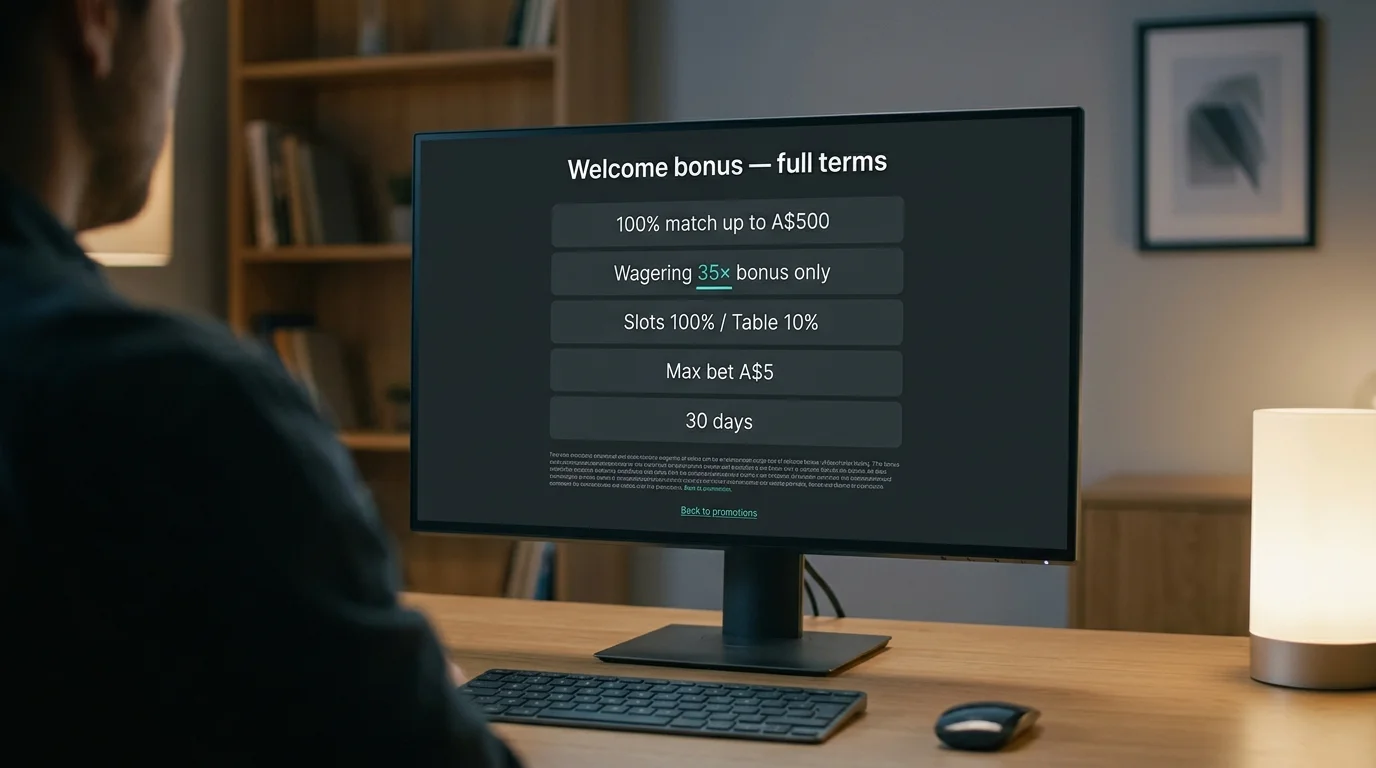
The most common misconception I hear at the dinner table whenever I mention what I do for a living is that PayID-casino bonuses are somehow different from other casino bonuses. They’re not. PayID is a deposit method — a banking rail, nothing more. Bonuses are operator-side marketing instruments. The two layers are independent, and the only time they interact is when an operator decides to bolt a small percentage uplift onto deposits that happen to arrive through PayID. Everything else — wagering, contribution tables, max-bet rules, expiry — is identical regardless of how the money got into the cashier.
The second thing to internalise before reading anything else on this page is the difference between a cached bonus and real money. A cached bonus sits in a separate balance, can’t be withdrawn until wagering completes, and may be voided if you breach a term. Real money is the deposit, and it’s withdrawable from the moment it lands. Most welcome offers blur this on purpose by displaying a combined balance — A$200 deposit + A$200 bonus = A$400 balance — but the underlying split matters enormously, because every spin you make is drawing from one of those two pots according to rules that aren’t always transparent.
Australia’s online gambling market is now estimated at A$5.5 billion in 2025 — that’s a lot of operators competing for a relatively concentrated player base, which is why bonus marketing has become so aggressive and so unreadable. The arithmetic on bonuses got worse as competition got harder. This piece pulls apart the maths.
Operators rotate the labels and shuffle the dressing, but in practice almost every PayID-casino bonus you’ll meet falls into one of seven structural categories. Knowing which category you’re looking at is the first step to evaluating whether the offer is mathematically rational or marketing theatre.

Welcome match is the headline product. You deposit, the operator matches some percentage of your deposit up to a cap, and the matched amount lands as bonus balance subject to wagering. The numbers vary wildly — 75 per cent to 300 per cent matches, caps from A$200 to A$3,000 per stage — but the structure is constant.
No-deposit is the second category. The operator credits a small bonus balance — typically A$10 to A$50 — to a freshly verified account before any deposit happens. The wagering is harsher and the maximum cashout is capped, but it’s the only category where you can theoretically end up ahead without depositing anything.
Free spins is the third. Sometimes standalone, sometimes layered onto a welcome match or no-deposit. Each spin runs at a fixed value — A$0.10 to A$0.50 typically — on a specific slot or small pool of slots. Winnings from spins almost always carry wagering on the winnings themselves.
Reload bonuses are the fourth category and the one most punters underrate. These are smaller matches — usually 25 per cent to 75 per cent — applied to deposits after the first, often on a weekly cadence. The wagering is typically lower than welcome match wagering, which often makes reloads the better long-term value than the headline welcome offer.
Cashback is the fifth — a percentage of net losses returned, weekly or monthly. The percentage looks tiny (5 to 15 per cent) but compounded over a year on a regular player it’s a real reduction in expected loss.
VIP rakeback is the sixth, applied to tier-laddered accounts and computed on total wagered rather than net loss. And tournaments are the seventh — periodic prize pools split among the highest-wagering or highest-multiplier finishers in a defined window.
Let me walk you through a calculation, because every reviewer skips this and it’s the only way to understand what you’re actually being offered. The typical PayID-casino welcome match runs 100 per cent up to A$500 with wagering at 35 times the bonus value, slots contributing 100 per cent and table games contributing 10 per cent. Almost every variation you see on this is just a different number plugged into the same formula.
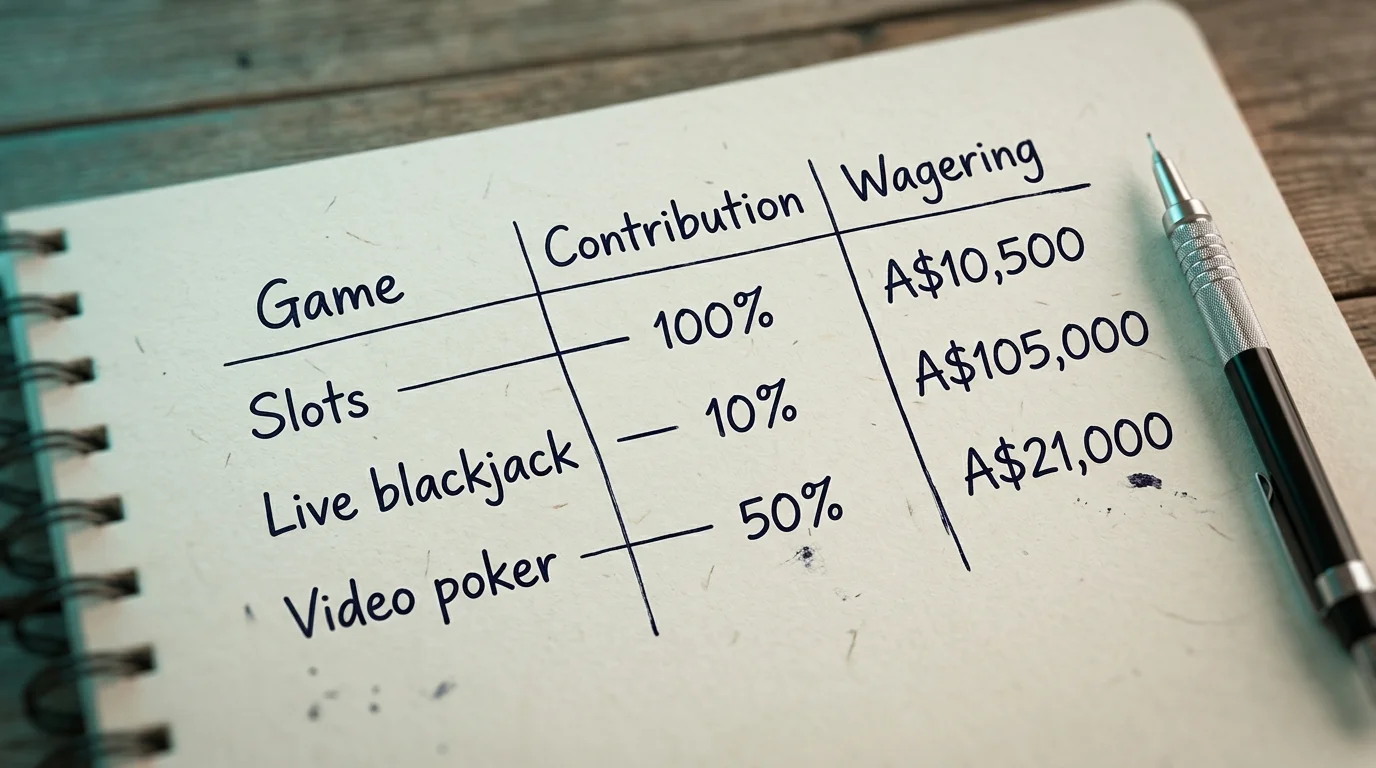
Suppose you deposit A$300. The match is 100 per cent up to A$500, so the bonus balance lands at A$300. Combined balance shown in the cashier reads A$600 — A$300 deposit and A$300 bonus. Wagering is 35 times the bonus, so the required turnover is 35 × A$300 = A$10,500. If you play slots exclusively, every wagered dollar contributes A$1 to the turnover requirement. If you play blackjack, every wagered dollar contributes A$0.10. So you can satisfy the wagering by spinning A$10,500 on slots, or by wagering A$105,000 on blackjack — same goal, very different volumes.
The minimum deposit to activate the offer matters too. Most PayID casinos run minimum activation deposits between A$10 and A$30. Drop below the minimum and the bonus simply doesn’t credit. Some operators also cap the bonus value at the deposit value — so a A$20 deposit on a 100 per cent up-to-A$500 offer gets you only A$20 of bonus, not A$500.
The economically important number, after all that, is expected loss during the wagering cycle. On a 96 per cent RTP slot the house edge is 4 per cent, so expected loss across A$10,500 of turnover is approximately A$420. You started with A$300 deposit plus A$300 bonus = A$600. After clearing wagering, your expected balance is A$600 minus A$420 = A$180. You came in with A$300 and you expect to end with A$180. The “bonus” cost you A$120 in expected value to keep. That’s not the operator’s pitch, but it is the maths.

No-deposit bonuses are the unicorn category of PayID-casino marketing. The minimum deposit across most operators sits in the A$10 to A$30 band, and no-deposit offers are typically structured below that floor — you’re being given A$10 to A$50 of bonus balance just for verifying an account. Sounds like free money. The terms make sure it isn’t.
The arithmetic on no-deposit is brutal by design. A typical offer credits A$25 bonus balance with wagering at 50 times — that’s A$1,250 of required turnover on a balance that starts at A$25. The maximum cashout if you do manage to clear wagering is capped, usually at A$50 to A$150, regardless of how high you ran the balance during play. So even a wildly fortunate punter who turned A$25 into A$800 during wagering walks out with A$50.
The expected value of the average no-deposit offer is positive but tiny — a few dollars at best — and it’s heavily right-tailed. Most players will burn through the A$25 well before completing wagering. A small minority will clear and cash out the cap. The aggregate is a known small loss for the operator that’s worth it as a customer-acquisition cost.
That said, no-deposit is the only category where you can’t go negative — you didn’t deposit, so worst case you’ve lost time. It’s also useful as a sample of the operator’s cashier and KYC processes before you commit real money. For the current list of structures and codes in this category, see the current no-deposit offer list and codes, which I update each quarter as offers rotate.
Free spins look like the easiest bonus category to evaluate — 100 free spins is 100 free spins, right? Wrong, and the gap between perceived and actual value is where most punters lose money on what feels like a free product.
Each free spin has a fixed cash value. Typical values in the PayID-casino market sit between A$0.10 and A$0.50 per spin, with A$0.20 being the median. So 100 free spins at A$0.20 represents A$20 of fixed value, before any winnings or wagering considerations. Compare that to the headline of “100 free spins” and the marketing weight does its work — A$20 sounds much less generous.
Free spins are also restricted to specific titles, normally one named slot or a small pool of three to five. The pool is chosen by the operator, not by you, and it’s almost always a low-to-medium volatility slot rather than the high-volatility titles that produce big wins. This is deliberate — the maths is calibrated to deliver predictable, small spin outcomes that the wagering can chew through.
Winnings from free spins are virtually always subject to wagering on the winnings themselves, separate from any other wagering on the welcome match they might be paired with. A typical clause is 30 to 50 times the winnings amount. So if your 100 spins produced A$32 of winnings, you’ll need to wager that A$32 between A$960 and A$1,600 times before withdrawal becomes possible. Expiry windows on this wagering are tight — typically 24 to 72 hours.

Welcome offers are a single transaction; everything beyond them — reloads, cashback and VIP — is where the operator’s long-term pricing actually happens, and where the more rational players quietly extract the value the welcome page never offered.
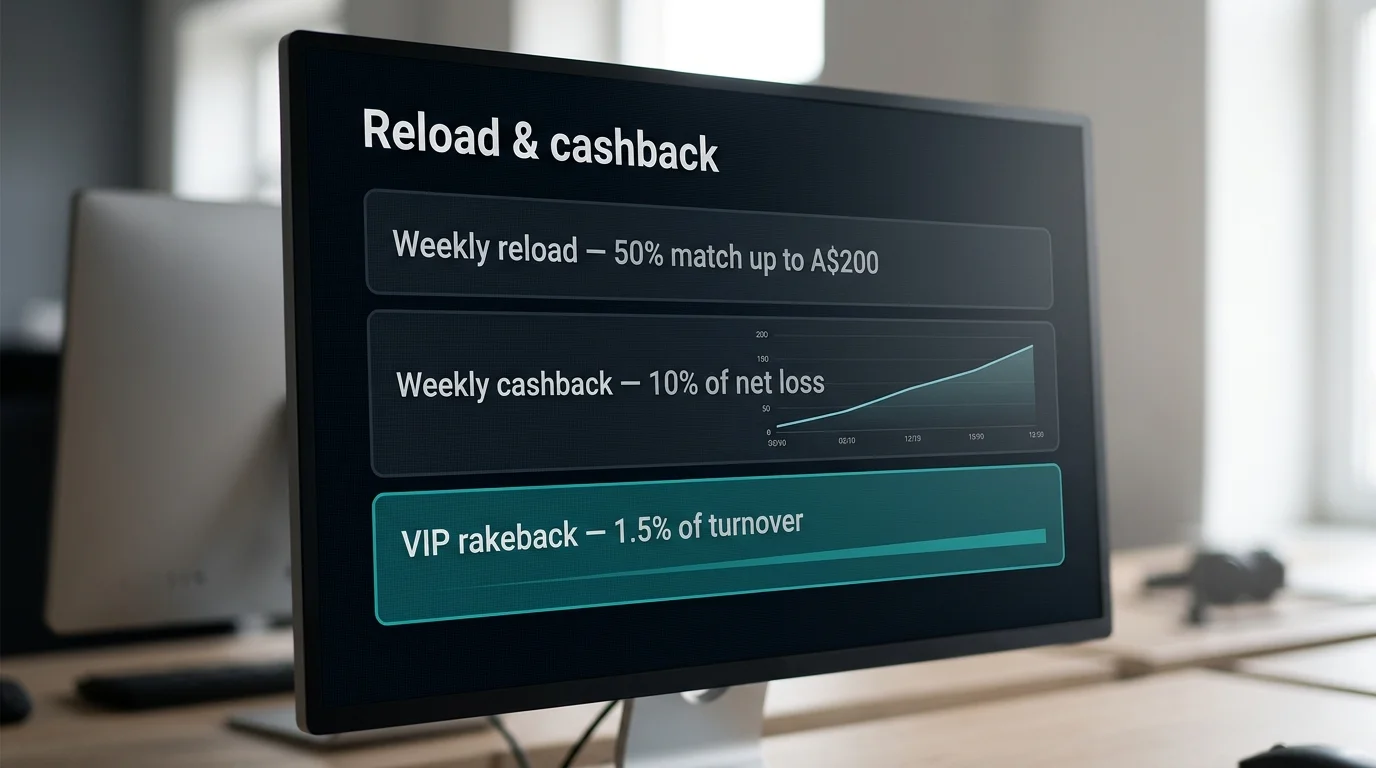
Reload bonuses are recurring matches on deposits after the first. Most operators run weekly reloads at 25 to 75 per cent of deposit value, with caps from A$50 to A$500, and wagering noticeably lower than welcome match wagering — typically 20 to 30 times rather than 35 to 50. The lower wagering shifts the expected-value calculation in the player’s favour, often making a 50 per cent reload at 25x wagering a substantially better deal than a 200 per cent welcome match at 50x.
Cashback is the long game. A weekly 10 per cent cashback on net losses, paid as real money or as withdrawable balance, is mathematically a 10 per cent reduction in your house edge across that period. On a 4 per cent baseline house edge that’s a 25 per cent reduction in expected loss — a meaningful number compounded across a year of play. The trap to watch for is cashback that arrives as bonus balance with its own wagering attached, which dilutes the value by a factor of 4 to 6 depending on the multiplier.
VIP rakeback applies on total wagered rather than net loss, so it pays whether you’re up or down. Headline rates start around 0.1 per cent at lower tiers and climb to 1.5 per cent at the top tier of most programs. Sounds tiny, but on a player wagering A$50,000 a month, 1.5 per cent rakeback is A$750 a month of pure return — more than most welcome offers pay over their entire lifespan.
A wagering multiplier is the number that the bonus pretends doesn’t exist on the headline ad. Every welcome offer carries one, and the difference between 30x and 60x is the difference between a workable offer and a marketing trap. Let me unpack the mechanics with enough detail that you can run the maths yourself on anything you encounter.
The first question is what the multiplier multiplies. “Wagering 35x” can mean three different things: 35 times bonus only (B), 35 times deposit plus bonus (D+B), or 35 times deposit only (D, which is rare and operator-friendly). On a A$200 deposit and A$200 bonus, those three options demand A$7,000, A$14,000 and A$7,000 of turnover respectively. The D+B variant is twice the workload for the same headline number. Always check which formula the T&Cs specify.
The second question is which games contribute to the turnover. Slots almost universally contribute 100 per cent — every A$1 wagered counts as A$1 toward turnover. Live dealer and table games contribute 10 to 20 per cent — every A$1 wagered counts as A$0.10 to A$0.20. Video poker varies. Some specific high-RTP titles are excluded entirely from the contribution table, and the exclusion list is the place where operators hide their biggest house-edge plays.
The third question is time. Most operators give you 14 to 30 days to complete wagering on a welcome match, and 24 to 72 hours on the wagering attached to free-spin winnings. Missing the window voids the remaining bonus balance and any winnings derived from it. The clock is a real constraint — on a A$10,500 turnover requirement at A$2 average spin size, you’re spinning 5,250 times, which is roughly 14 to 16 hours of actual play.
This matters more than the headline ad lets on, and ANU researchers tracking Australian gambling participation in 2025 have been blunt about why: “Findings highlight intensifying harm despite declining participation, highlighting a critical need for regulatory and public health responses targeting online gambling.” Risky gambling rose from 13.7 per cent in 2024 to 19.4 per cent in 2025 even as overall participation slipped — and bonus wagering structures are part of why the harm intensifies without the headcount growing. The bonus pushes you to wager more than you would otherwise, the wagering pushes you to keep wagering past the point where you’d otherwise stop, and the deferred-cashout structure deactivates the natural off-ramps you’d use in a no-bonus session.
Knowing the maths doesn’t change the maths. It changes whether you accept the offer.
Here’s a fact that confused me when I first started seeing it in operator T&Cs three years ago: some offshore PayID casinos now offer a small additional bonus — usually 10 to 20 per cent — specifically on deposits made through PayID rather than other methods. They label these things variously as “PayID Boost” or “Instant Deposit Bonus” or similar marketing constructs.
The mechanism makes commercial sense once you know it. PayID use rose by 18 percentage points across the Australian banking population in 2025, with around half of all RBA Consumer Payments Survey respondents reporting at least one PayID use in the prior year. Operators figured out that channelling deposits onto PayID reduces their own payment-processing costs — there are no card-network fees, no chargeback risk in the conventional sense, and the inbound funds clear immediately rather than sitting in a multi-day reconciliation buffer. They share a sliver of that cost saving with the player as a deposit-side incentive.
The economics on the player side are simple but worth doing. A standard 100 per cent welcome match up to A$500 plus a 10 per cent PayID boost effectively becomes a 110 per cent match. On a A$300 deposit, bonus value moves from A$300 to A$330. Wagering applies on the bonus value as before, so wagering at 35x on A$330 is A$11,550 of turnover — A$1,050 more than the unboosted version. The boost is genuinely better on EV, but only marginally.
What this category isn’t: a different wagering structure, a different contribution table, or a different cashout cap. Once the bonus credits, the maths runs identically to any other operator-side bonus. The PayID label is a deposit-channel marketing tag, not a structural change.
I’ve watched perfectly sensible punters surrender bonus balances and winnings worth four-figure amounts because of clauses they didn’t know existed. With around 65.1 per cent of Australian adults engaging in some form of gambling in the past 12 months — up sharply from 56.9 per cent in 2019 — bonus hunting has become an aggressive sport at the player level, which is exactly why the trap clauses have proliferated at the operator level. Here are the five trap clauses I’ve watched eat the most balances.
Max bet during wagering. Most welcome match T&Cs include a clause restricting your maximum wager per spin or hand while bonus balance is active — typically A$5 to A$10 per spin. Place a single spin above that and the entire bonus is void, including any winnings derived from it. The clause exists primarily to stop players from completing wagering with large single bets, and it fires by accident more often than by design — autoplay settings, max-bet buttons hit out of habit, currency-conversion edge cases.
Sticky vs non-sticky distinction. A sticky bonus stays in your balance until wagering completes and then disappears, with only winnings derived from it withdrawable. A non-sticky bonus sits in a separate pot — you play with deposit funds first, and the bonus only activates if you lose the deposit. Non-sticky is much friendlier to the player. The T&C will rarely use these specific words, but the mechanism is described in the wagering paragraph if you read carefully.
Withdrawal-during-wagering forfeiture. If you withdraw any amount while bonus balance is active and wagering incomplete, most operators void the entire bonus balance and any winnings derived from it. The player frequently doesn’t realise the bonus was still active because the cashier displayed a combined balance.
Game contribution exclusions. Specific titles — usually high-RTP slots and certain table game variants — count for 0 per cent toward wagering rather than 100 per cent. You can wager on them all day and the requirement won’t budge. The exclusion list is often hidden in a separate document rather than the bonus T&C itself.
Country and method exclusions. Some bonuses exclude specific deposit methods or specific countries from eligibility. PayID is rarely excluded but is occasionally restricted to certain bonus tiers. Always cross-check before depositing.

When I evaluate a new welcome offer, I read the T&Cs in a specific order — not top to bottom, because the page is engineered to bury the important clauses below the friendly ones. After enough cycles you develop a hunting pattern, and here’s mine.
First I find the wagering multiplier and the base it’s applied to. “35x” means nothing without knowing whether it’s 35x bonus, 35x deposit-plus-bonus, or 35x deposit. This is the single most consequential number on the offer.
Second I find the maximum bet during wagering. If it’s below A$5 per spin, I make a mental note to disable autoplay max-bet features before depositing. If it’s A$10 or higher, I’m comfortable.
Third I find the game contribution table — slots percentage, live dealer percentage, table games percentage, and any excluded titles. The table tells me which games I can actually use to satisfy the requirement.
Fourth I find the maximum conversion or maximum cashout clause. Some bonuses cap how much of the bonus-derived winnings you can withdraw, regardless of how high your balance went during wagering. Common caps run 5 to 10 times the bonus value.
Fifth I find the time window. 14 days is tight, 30 days is standard, 60 days is friendly. Free-spin winnings often carry a separate, much shorter window.
Sixth I find the country exclusion and method exclusion list. Australia rarely gets excluded from offshore casino bonuses, but it does happen, and the exclusion is usually buried near the end of the document.
Seventh — and this is the one most reviewers skip — I look for the “irregular play” or “bonus abuse” clause. This is the operator’s discretionary lever to void a bonus if they decide your play pattern looks like bonus farming. There’s nothing you can really do about this clause’s existence, but knowing it’s there shapes how aggressively you should pursue wagering completion.
The arithmetic in this article boils down to one observation: a welcome match with wagering at 60x and a A$5 max-bet trap is a marketing instrument that costs you money in expected value, no matter how generous the headline percentage looks. A welcome match at 30x with no max-bet clause and slots contributing 100 per cent is worth taking. Reload bonuses and cashback in real money are almost always more efficient than chasing the biggest welcome number.
Treat bonus offers the way you’d treat a contract you’re being asked to sign — read the clauses, run the maths, and walk away from the ones that don’t survive the arithmetic. The operator wrote the T&Cs knowing what they want the result to look like. You’re allowed to want a different result.
A practical guide to game mechanics, licensing, mobile pokies, bonuses, deposits and safer real-money play. How Microgaming Slots Work: RNG, RTP and Variance Microgaming-style slots are governed by the same…
Understand the checks, payment routes and account conditions that determine how quickly…
A clear guide to Australian restrictions, mobile game formats, RTP information, and…
Understand the payment process, verification requirements and legal and banking conditions for…
Written by the editors at casinopayidau.com.