Disclaimer
Last updated: 28.09.2026 Information Only The content published on casinopayidau.com is provided for general informational purposes only. Nothing on this site constitutes legal, financial, or professional advice, nor does it…

Regulatory audit: IGA 2001, ACMA, AUSTRAC scambling, BetStop and AFCA. What protects Aussie players at PayID casinos — and what does not
 Available in AU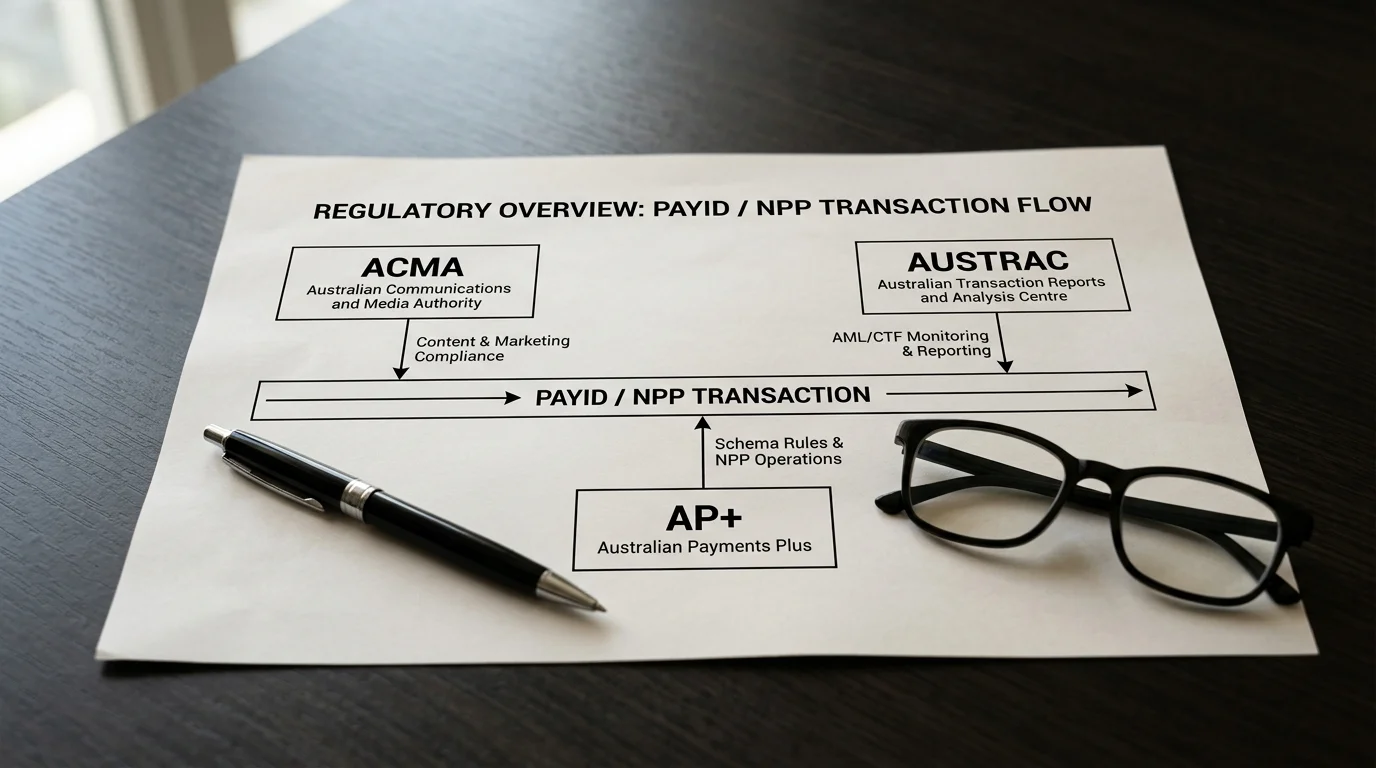
The first time a relative of mine asked whether “PayID casinos” were legal, I made the mistake of giving the short answer — “the casino bit isn’t, the PayID bit is” — and ten minutes later they were even more confused than when we started. The problem isn’t that the answer is hard. The problem is that “is it safe” and “is it legal” are two different questions, and “PayID” and “casino” are two different things, and most online explanations smash all four together into one mush.
So let me lay this out the way I should have done it for my relative. PayID is a banking service governed by the New Payments Platform and administered through Australian Payments Plus and the Reserve Bank’s payments oversight. It is fully regulated, banked-grade, and as safe as any transfer between two Australian bank accounts. The risk on the PayID side of the equation is essentially nil for legitimate use.
A casino that accepts PayID, on the other hand, is almost always an offshore operator with no Australian licence — because the Interactive Gambling Act 2001 prohibits operators from offering online casino games to Australian residents. So the casino layer carries operational, financial and legal risk. Two completely different layers of risk, stacked on top of each other through a single transaction.
This piece audits both layers. What the regulators actually do, what they don’t do, what protects you, what doesn’t, and what to do if any of it goes wrong.
The Interactive Gambling Act 2001 is the foundational piece of Commonwealth legislation here, and roughly 80 per cent of the misconceptions I encounter come from people who’ve heard of it but never read what it actually does. I’ll save you the trip to the legislation portal.
The Act prohibits the provision of “interactive gambling services” to people physically present in Australia. The key word is “provision” — the operator commits the offence, not the consumer. The Act explicitly does not criminalise the player. You can deposit at an offshore casino, win, lose, withdraw, do all of it, and you have committed no offence under Australian law. This is the single most important fact in the entire regulatory landscape, and it’s the one most reviews bury or omit.
“Interactive gambling service” is defined broadly to cover online casino-style games — pokies, blackjack, roulette, baccarat, video poker — but it excludes sports wagering on licensed Australian bookmakers, lottery products, and certain other categories that have their own carve-outs. So an Australian sportsbook licensed by a state regulator is fine. An offshore online casino offering pokies to Australian players is not. The operator’s offence carries civil penalties up to A$247,500 per day of contravention.
What the Act does to enforcement is delegate the heavy lifting to the Australian Communications and Media Authority — the ACMA. ACMA can investigate complaints, refer matters to internet service providers for blocking, issue formal warnings, accept enforceable undertakings, and recommend civil penalties through the courts. ACMA is not a body that fines players. It is a body that fines and disrupts operators.
The practical implication for an Australian punter is this: the legal jeopardy is not yours. The financial jeopardy of dealing with an operator who’s outside the regulator’s enforcement reach is yours entirely. You won’t get arrested, but you also won’t get help if your money disappears into a fraudulent site.

ACMA’s enforcement record is more substantial than most punters realise, and the numbers are public. Since November 2019, when ACMA started keeping a public count, the regulator has prompted blocking of around 1,455 illegal gambling and affiliate sites by Australian internet service providers. Around 220 illegal services have also exited the Australian market voluntarily under regulatory pressure since 2017. These aren’t symbolic gestures — the blocking actually breaks the operator’s ability to reach Australian players through normal browser traffic.
The complaint flow at ACMA is steady. In Q3 of calendar 2025 alone — July, August and September — ACMA fielded 411 complaints about online gambling. Of those, 350 (around 85 per cent) fell under the Interactive Gambling Act. Twenty-nine investigations were finalised in that quarter. Twenty-eight found a breach. That close to a 100 per cent breach-finding rate tells you what kind of complaints actually escalate: the obvious ones, where the operator is plainly outside the rules and is either unable or unwilling to argue otherwise.
Financial penalties have started to bite. Betchoice — a domestic operator that breached IGA obligations — paid a A$1 million penalty in 2025, equivalent to roughly USD$658,000, and accepted a two-year enforceable undertaking. Ultrabet and PointsBet have entered eighteen-month undertakings for related breaches. None of these enforcement actions are against the punter. They are all against the operator.
ACMA’s chair Nerida O’Loughlin has been about as direct as a regulator gets on the question of operator obligations: “Providing casino-style games online is prohibited in Australia when playing for money or something of value, whether that’s Australian dollars, cryptocurrency or in this case, online gaming skins.” The statement was issued in the context of skin-betting platforms but the principle generalises across every offshore casino offering.
The takeaway is straightforward. ACMA polices the operator side reasonably well, which slowly erodes the worst-behaved operators from the market. The regulator does not — and structurally cannot — recover individual player funds from an offshore site that decides not to pay. That’s not a failure on ACMA’s part; it’s a definition of jurisdiction.

The most important regulatory development in the AU PayID-casino space in the last 18 months landed quietly in December 2025, in a joint AUSTRAC and Fintel Alliance report that almost no consumer-facing publication has covered properly. AUSTRAC named the scheme: “scambling”. It’s a portmanteau of “scam” and “gambling”, and it describes a coordinated fraud pattern where what looks like a small offshore casino is actually a money-mule operation using PayID to launder funds.
“We’re seeing a rise in so-called ‘scambling’, where unlicensed online gambling platforms advertise on social media and trick people to visit a scam website to participate in gambling,” AUSTRAC’s CEO Brendan Thomas said in a speech at last year’s Regulating the Game conference. “Players are then asked to deposit funds into a PayID but it’s highly unlikely they will ever see their winnings from these sites.”
The mechanics are vicious in their simplicity. The “casino” is a polished but shallow website, often built on a template that mimics legitimate offshore operators. The site advertises on social media — particularly Instagram and TikTok — to demographics with high gambling propensity and lower regulatory literacy. The deposit method offered is PayID, which routes money to an account owned by a money mule rather than to a casino operator. The “casino” software allows the player to win during a free-spin or first-deposit period, then increasingly throttles or fails on withdrawal requests. Eventually the player can no longer access funds. The mule account is closed. The “casino” rebrands under a new domain. The fraud cycle restarts.

By December 2025, the Fintel Alliance — a public-private financial-crime partnership AUSTRAC coordinates — had been actively running pattern-recognition work against scambling since identifying the scheme in 2024. PayID is the favoured channel specifically because it bypasses the gambling-related MCC 7995 transaction code that banks use to monitor card-based betting. PayID transactions don’t carry a gambling MCC at all — they look, from the bank’s monitoring perspective, like person-to-person transfers.
The data Fintel Alliance has been working with is substantial. AUSTRAC received and analysed data on over 50 million below-A$10,000 cash deposit transactions from Australia’s four largest banks, looking for the cash-then-PayID pattern that mules use to convert proceeds before pushing them through the scambling pipeline. For specific case studies of scambling sites and the way each red flag presents in the wild, see the scambling case studies and red-flag list.
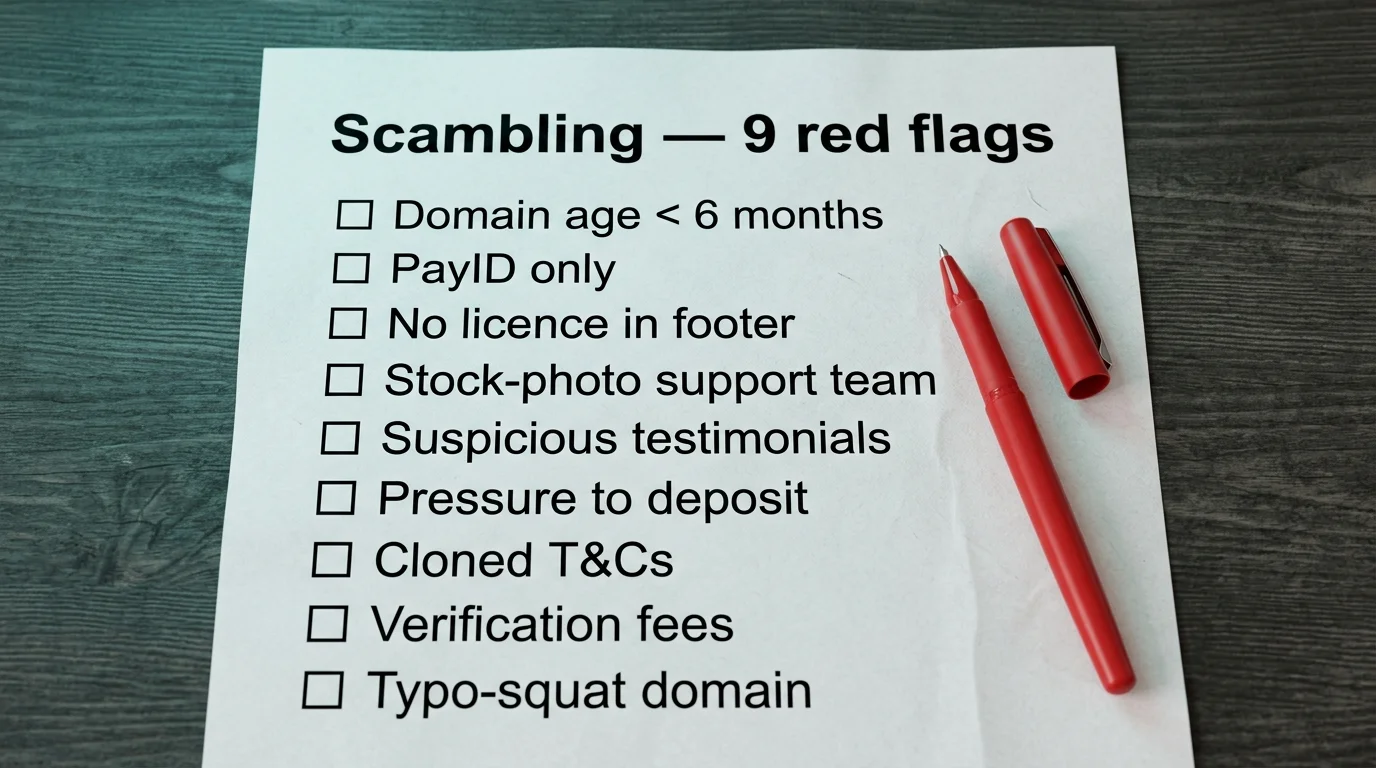
The Fintel Alliance pattern analysis surfaces a consistent profile for scambling sites, and after enough hours of looking at the data, the flags become almost embarrassingly easy to spot. Nine signals stand out, and the presence of three or more should send you elsewhere immediately.
One: domain age under six months combined with substantial advertising spend. A real offshore operator typically nurtures a domain for years before pushing major social-media campaigns. A new domain pushing aggressive ads on Instagram is the canonical scambling signature.
Two: PayID as the only available deposit method. Legitimate offshore operators carry PayID alongside two or three alternatives — Neosurf vouchers, bank transfer, sometimes a still-operational eWallet. PayID-only is the cleanest single red flag.
Three: no licence number in the footer, or a licence reference that doesn’t resolve to a verifiable status on the licensor’s portal. Curaçao, Anjouan and Kahnawake all publish status-check tools. A licence that can’t be confirmed is functionally an unlicensed operation.
Four: stock-photo “support team” portraits and a Live Chat that responds with generic templates. Real support teams have inconsistent response timing and language quirks; templated chat is the cheapest tell.
Five: customer “winnings” promoted in social-media testimonials with screenshots that show suspiciously round amounts and recent post timestamps. Real players don’t produce sanitised marketing copy.
Six: pressure to deposit during the initial chat conversation, particularly with “today only” pseudo-bonus offers that fade if you mention waiting. Genuine operators don’t structure their welcome flow this way.
Seven: T&Cs that read as cloned from another site, with mismatched company names or jurisdictional references appearing in odd places. Copy-paste fraud betrays itself fast in legal language.
Eight: a withdrawal process that requires “verification fees”, deposits to “unlock” winnings, or any other movement of money from you to them after the initial deposit. No legitimate operator charges to release a withdrawal.
Nine: domain name very close to but not identical to a legitimate operator. Scambling sites frequently typo-squat or use a TLD swap to capture confused brand-recall traffic.
KYC verification at an offshore operator typically requires three documents: a government-issued photo ID (Australian driver licence or passport), a proof of address dated within the last three months (utility bill, bank statement, or government correspondence), and frequently a selfie holding the ID. The operator’s compliance team reviews these against the registered account name and the PayID alias name to confirm identity coherence.
The data-protection question almost no review covers is what happens to those documents after verification. Australian privacy law — the Privacy Act 1988 and the Notifiable Data Breaches scheme — does not extend extraterritorially to offshore operators in any practical sense. Your KYC documents at an offshore casino are governed by the operator’s home jurisdiction, which for Curaçao-licensed operators is loose, and for some other licensors is essentially absent.
Operators with multi-year reputations typically maintain at least minimum security hygiene around KYC storage — encrypted databases, restricted access controls, document expiry after some retention period. New or thinly-staffed operators may not. The breach risk is real, and the recovery options if a breach occurs are limited because your contractual counterparty is in a jurisdiction where you have no realistic enforcement reach.
The practical mitigation: use documents that are genuinely required, don’t volunteer more than the operator asks for, mask any account numbers or sensitive data on proof-of-address documents that aren’t relevant to identity verification, and never upload a credit card photo unless the operator absolutely insists on it (and reconsider depositing with them if they do, since cards are no longer a permitted online-betting method).
The 11th of June 2024 is the date that reshaped Australian online-betting payments more than any single event in the previous decade. From that day forward, using credit cards and cryptocurrency for online wagering became prohibited at the licensed-operator level, with penalties up to A$247,500 per day of contravention. The ACMA reports a very high level of compliance with the ban — no investigations needed to be opened, and by mid-2025 around 50 licensed operators had removed credit card and crypto language from their terms.
The minister responsible at the time, Amanda Rishworth, framed the change directly: “Our government takes seriously our responsibility to prevent and reduce harm from online wagering. Our ban on credit cards will help with this goal. You can’t use your credit card to place a bet for land-based gambling. Now the same rules apply for online gambling.”
The economic effect on the offshore casino market — which technically operates outside the licensed sector but tracks payment-method availability in step with it — was immediate. POLi had already shut down in 2023. Cards were now off the table for compliant operations. Crypto was off the table for licensed operations and increasingly difficult to access at offshore operators because of bank-side de-risking of crypto on-ramps. PayID was suddenly the only major rail still functional, still fast, still free of transaction fees.
This isn’t an endorsement of PayID over the alternatives — it’s a description of what happened when the alternatives collapsed. PayID didn’t win on merit alone. It won because everything else was either banned, shut down, or pushed to the margins. The dominance creates concentration risk: a single payment method becoming the only viable deposit channel means a single point of failure in the player’s payment options, and an outsized target for fraud schemes like scambling that have correctly identified PayID as the highest-volume channel to exploit.
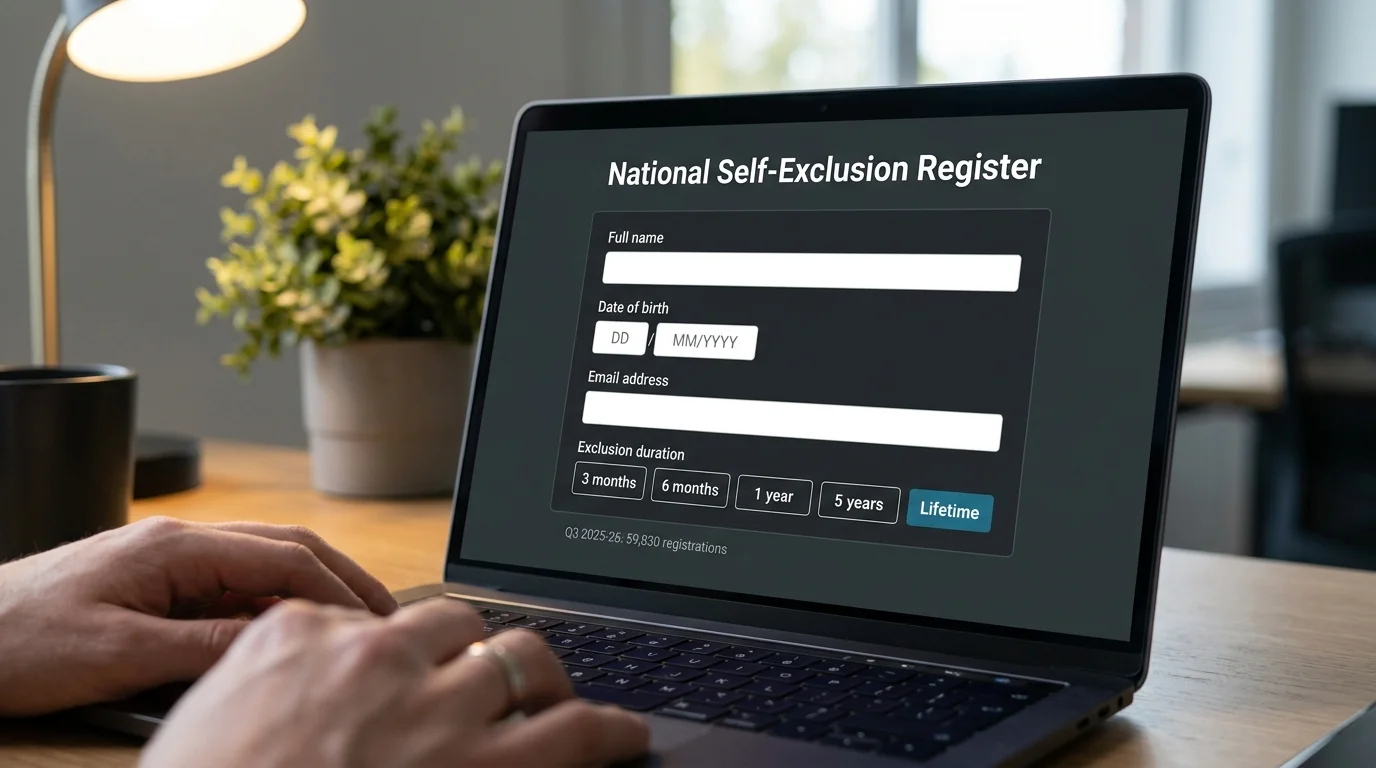
BetStop, the National Self-Exclusion Register, launched in August 2023 and gives any Australian resident a free, fast way to exclude themselves from all licensed Australian online wagering services in a single registration. The numbers are climbing steadily. By the end of Q1 of the 2025–26 financial year (September 2025), 49,382 people had registered with BetStop since launch, and 31,838 self-exclusions were active. By the end of Q3 — 31 March 2026 — registrations had reached 59,830, with 37,247 active exclusions. New South Wales accounted for 18,601 registrations, Victoria 16,063, and Queensland 12,310.
The most popular duration choice is striking. Among Q1 2025–26 registrations, 39 per cent of users selected a lifetime self-exclusion — the most permanent option available. Another 38 per cent chose between three months and two years. Only 18 per cent opted for the minimum three-month period. That distribution tells you something important about who actually uses BetStop: it’s not casual time-outs from a heavy weekend; it’s people making a structural decision about their relationship with gambling.
The technical scope of BetStop covers all licensed Australian wagering operators — sportsbooks, totes, lottery products. It does not cover offshore casinos, because offshore operators are not within Australian regulatory reach. That limitation matters for the PayID-casino conversation: registering on BetStop does not automatically block you from depositing through PayID at an offshore site. The protection is partial. If self-exclusion is the goal and offshore casinos are part of your concern, BetStop registration needs to be paired with bank-side blocks on gambling-tagged transactions and, ideally, an honest conversation with someone you trust.
The Scams Prevention Framework Bill passed federal parliament on 13 February 2025 and started reshaping the landscape for scam victims through 2025 and 2026. The mechanism most relevant to PayID-casino fraud is the change to the Australian Financial Complaints Authority’s jurisdiction, effective 12 March 2026.
Before 12 March 2026, AFCA’s jurisdiction over scam-related disputes was confined mostly to actions by the sending bank — the bank that processed the outgoing transfer at the victim’s instruction. The receiving bank — the institution holding the money mule’s account — was generally outside AFCA’s complaint reach. From 12 March 2026, AFCA can consider the conduct of receiving banks in scam scenarios, including whether the bank failed to detect or act on red flags around the account that received the funds.
What this means practically for a scambling victim: if you can establish that the receiving bank had reasonable grounds to identify the destination account as a money mule (rapid in-and-out transfers, multiple unrelated incoming credits, abnormal balance patterns) and failed to act, AFCA can now consider whether the receiving bank has shared liability for the loss. This is a significant expansion. It doesn’t guarantee recovery, but it opens a complaint pathway that didn’t exist before.
The Scams Prevention Framework also strengthens the obligations on telecommunications carriers and digital platforms — including social media — to detect and act on scam advertising. The scambling pattern relies heavily on social-media ads. The framework gives platforms enforceable obligations to act faster on flagged accounts, and gives regulators (the ACCC for the framework, AUSTRAC for the AML/CTF angle) more enforcement tools.
None of this helps if you’ve already been scammed before 12 March 2026 — the changes are not retrospective. But for losses sustained from that date forward, the recovery toolkit is meaningfully wider than it was in 2024.
The honest first sentence here is that recovery rates from offshore casino scams have historically been low. Once funds leave an Australian bank account via PayID and land in a money-mule account that’s been emptied and closed within hours, the realistic recovery probability sits in the single digits. That said, the sequence of actions matters because some of them are time-sensitive and skipping the early steps closes doors that the later steps depend on.
Step one, within minutes if possible: contact your bank’s fraud team via the dedicated fraud line, not the regular customer service line. Australian banks operate the New Payments Platform’s recall function, which can in theory pull back a transfer if the receiving institution still holds the funds. The window is short — usually under an hour for any chance of success — but it’s the only step that has the potential for fast recovery.
Step two, within 24 hours: lodge a Scamwatch report through the ACCC’s portal. This doesn’t directly recover your funds, but it creates a documented record that supports later AFCA, AUSTRAC and law enforcement processes. Scamwatch reports also feed into the pattern-detection databases that help identify the operating mule networks.
Step three, within a few days: file a complaint with AFCA against your sending bank if you believe they failed to act on visible warning signs in your transaction pattern. From 12 March 2026 onward, also consider including the receiving bank in your complaint where you can identify it.
Step four: lodge a report with ACMA about the offshore operator. This won’t recover funds either, but it contributes to the regulator’s evidence base for blocking and enforcement actions against the operator.
Step five: file a SuspMatter — Suspicious Matter Report — with AUSTRAC if you have specific intelligence about the operator (domain names, social-media accounts, payment patterns). AUSTRAC builds out the Fintel Alliance analysis from individual reports, and a detailed SuspMatter contributes to longer-term disruption even when it doesn’t help your individual case.
What none of these steps will do is restore your funds with high probability. Realistic expectation management is part of the recovery process. Treat the first hour as your real chance, and everything after that as contributing to the systemic disruption of the scheme that will eventually protect someone else.

The audit boils down to a clean separation. The PayID rail itself is safe — bank-grade, well-regulated, no realistic transaction-level risk. The offshore casino layer is not regulated by Australian authorities at the licensing level, is not within ACMA’s enforcement reach for individual disputes, and contains an active fraud subsector that AUSTRAC has been tracking under the scambling label since 2024. You are not at legal risk as a player. You are at financial risk, and the regulator can’t follow your money offshore to help you recover it.
The Scams Prevention Framework changes coming on 12 March 2026 widen the recovery toolkit, but the protection still arrives after the loss. Prevention — the licence check, the domain age check, the PayID-only red flag, the deposit pressure test — sits on you, not on the regulator. That’s the part most reviews don’t say out loud, and it’s the part that matters most.
Last updated: 28.09.2026 Information Only The content published on casinopayidau.com is provided for general informational purposes only. Nothing on this site constitutes legal, financial, or professional advice, nor does it…
A practical overview of rooms, nearby hotels, access, dining, parking and non-gaming…
Explore how RNG, RTP, variance, mobile features, deposits and free-play options shape…
Explore slot mechanics, game formats, casino terms, mobile play, payments and Australian…
Written by the editors at casinopayidau.com.