
PayID Casinos in Australia: The Complete 2026 Guide for Aussie Players
Bank-rail betting, the way Aussies pay now.
 Available in AU
Banking Rails Meet Offshore Casinos: A 2026 Snapshot
A reader in Hobart sent me a transcript last month — his first PayID deposit at an offshore casino had cleared in eleven seconds, and he was convinced this meant the operator was licensed in Australia. It is not. That confusion is the cleanest illustration of why I rewrite this guide every year.
I have spent nine years on the Australian iGaming compliance beat, and 2026 is the first year the cashier story has tipped almost entirely toward one rail. Credit cards were locked out for online betting in June 2024. Crypto at offshore operators sits under the same federal prohibition. POLi shut its servers in 2022. What is left, for an Australian who wants to move AUD in real time, is PayID.
A "PayID casino" is not a regulated product category. It is shorthand for an offshore operator — usually licensed in Curaçao, Anjouan or Costa Rica — that accepts deposits and pays withdrawals over the New Payments Platform. The rail itself is owned by Australian Payments Plus and supervised by the RBA. The casino at the other end of that rail is not.
What 2026 changed — the AFCA jurisdiction expansion on 12 March 2026 now covers receiving-bank actions in scam transfers, the AUSTRAC-led Fintel Alliance has a named workstream on PayID-channelled illegal gambling, and the ACMA has paired its growing blocklist with enforceable undertakings on multiple onshore operators. Offshore casinos do not appear on those undertakings. They appear on the blocklist.
The Five-Minute Brief on Aussie PayID Casinos
- PayID itself is a legal Australian bank service; offering casino games over it is forbidden to the operator under the Interactive Gambling Act 2001, and never a criminal act for the player.
- Deposits clear in under 60 seconds; payouts land roughly 0–24 hours after the operator approves them. Your first KYC delays the first withdrawal, not the ones that follow.
- Big 4 daily PayID ceilings reach A$20,000–A$25,000 once raised inside the banking app; defaults sit at A$1,000–A$2,000.
- The real danger is not slow payouts but scambling — fake "casinos" advertised on social media that swallow PayID deposits and never pay out.
- Treat every PayID casino as offshore: verify the licence link, complete KYC up front, and never use a PayID alias tied to a public profile.
What Actually Lives Behind the Phrase "PayID Casino"
"PayID was built for the bottle shop, not for the cashier of an offshore casino." That is roughly what a product manager at Australian Payments Plus said to me at a payments conference in 2024, and the line has stuck because it captures the situation precisely. The rail is consumer infrastructure that the offshore casino industry rented in.

Strip the marketing language away. PayID is an identifier — your phone number, your email, your ABN, your organisation ID — that points to a bank account on the New Payments Platform. The NPP is the real-time settlement system connecting more than a hundred Australian banks, credit unions and mutuals, processing payments around the clock without batch windows. By the close of 2024 the NPP had cleared around 1.6 billion transactions worth roughly A$1.99 trillion, a year-on-year jump of 23 per cent.
Why does this matter to an Australian who wants to play pokies on an offshore site? Because the operator's cashier is just a banking endpoint. Once POLi shut down in 2022 and the credit card and crypto restrictions came into force in 2024, the offshore industry needed a way to move AUD from Australian retail accounts in real time, with no card scheme to enforce gambling MCC blocks. The NPP did not ask their permission. Banks were already pushing PayID to consumers — by mid-2025 more than 27 million PayIDs had been registered nationally — so the operator published an alias on its cashier page and let the customer transfer money in. The confidence the player feels is borrowed entirely from the bank brand.
PayID — an identifier (phone number, email, ABN, organisation ID) that maps to an Australian bank account, used to receive NPP payments without sharing BSB or account number.
NPP — the New Payments Platform, Australia's real-time A2A settlement rail launched in 2018, processing payments around the clock between participating financial institutions.
Osko — the consumer-facing payments service that runs on NPP, marketed by BPAY. A PayID transfer is, in practice, an Osko transfer at the rail level.
From Tap to Cashier in Under a Minute
The first time I watched a casino cashier confirm a PayID deposit, I missed the moment. The page refreshed twice, the balance went from zero to A$200, and the sequence took less than the time my coffee machine needs to grind a single shot. The rail really is that fast.
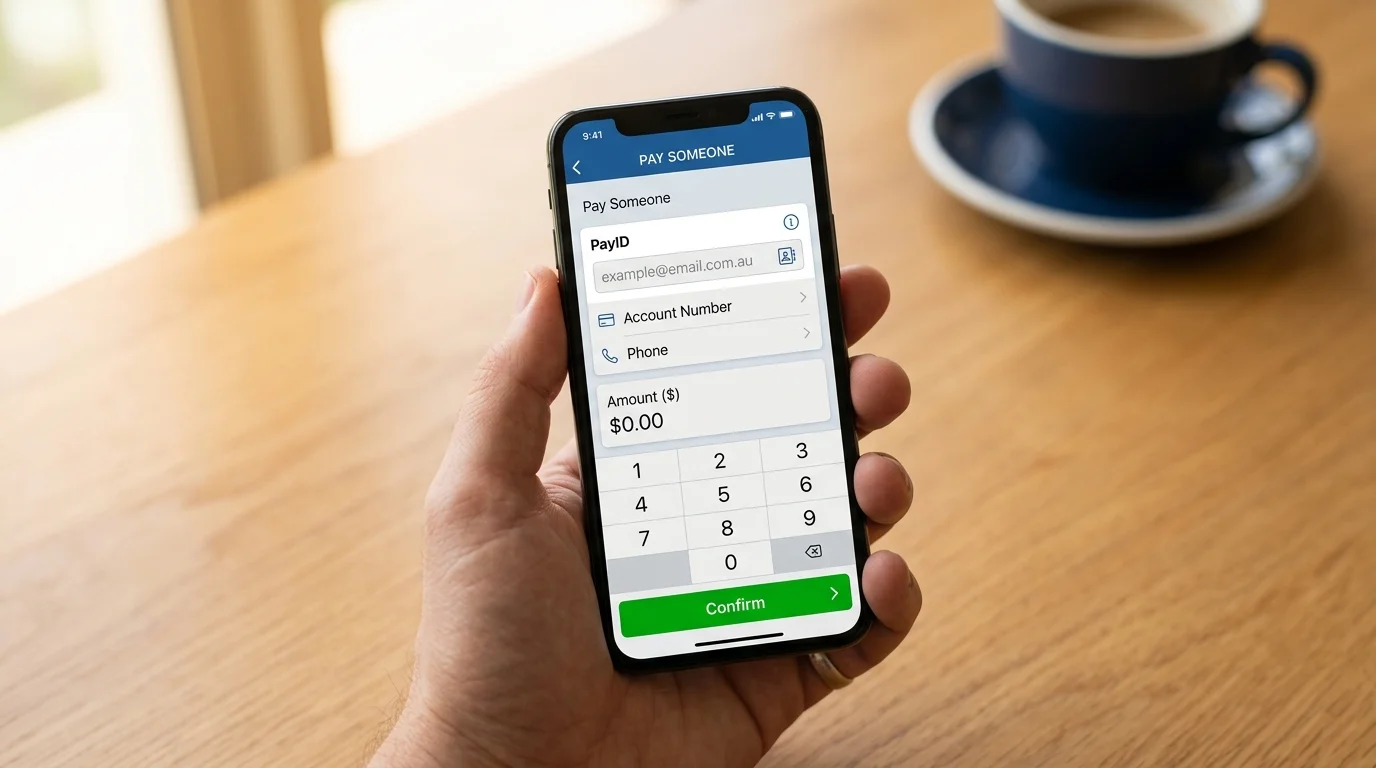
Here is what is happening behind the screen. The operator publishes a PayID alias on the cashier page — usually a unique phone number or email tied to its AUD settlement account. You open your banking app, hit "Pay Someone", paste or type the alias, and the bank's lookup service returns the registered name on that PayID. If the name matches what the cashier displayed, you enter the amount and confirm with biometrics or PIN. The NPP transmits a clearing message in real time; the receiving bank credits the operator's account; the cashier's webhook fires; your casino balance updates.
That whole loop ran almost 2 billion times across Australian retail in 2025 — not just casino traffic, but every birthday transfer, rent payment, freelancer invoice and council fine processed in real time. PayID itself, as a payment habit, grew by 18 percentage points last year. Lynn Kraus, who runs AP+, called the present moment an opportunity "to modernise Australia's payments system to support a more digitally enabled economy and enable greater competition, innovation and productivity." The offshore casino industry happens to be one of the beneficiaries, even if not the one Kraus had in mind.
Withdrawals run the same rail in reverse, with more friction inside the operator. You request a withdrawal; the operator's risk system holds it for review; KYC documents are checked against the alias name; treasury approves; the NPP-connected payment provider executes the outbound transfer; your bank credits within seconds. The NPP leg is near-instant — what eats the clock is everything happening on the operator's side before the transfer fires.
A typical deposit, logged on a Tuesday afternoon in May 2026
T+0 → paste alias into bank app, 4 seconds to type
T+4 → bank name-lookup returns recipient "AcmePay Settlements Pty", 2 seconds
T+6 → enter A$200, confirm with biometric, 6 seconds
T+12 → NPP clearing message lands at operator's bank, 1 second
T+22 → A$200 visible in casino balance, ready for play
Total: 22 seconds end-to-end, zero fees on either side.
Legal for You, Illegal for the Operator
Here is the question Australian players send me most often: "Am I breaking the law if I deposit at a PayID casino?" You are not. The operator is. That distinction is twenty-five years old and it has not moved.

The Interactive Gambling Act 2001 prohibits the supply of interactive gambling services — online casino-style games, online slots, online in-play wagering — to customers located in Australia. It is the operator who supplies the service. It is the operator who is on the hook. The player sits outside the criminal frame entirely.
Nerida O'Loughlin, who chairs the ACMA, has been consistent about where the prohibition bites: "Providing casino-style games online is prohibited in Australia when playing for money or something of value, whether that's Australian dollars, cryptocurrency or in this case, online gaming skins." The verb is "providing" — not "playing".
What the ACMA does looks like this. It investigates complaints, closes investigations with findings of breach, and pushes Australian ISPs to block offending domains. Since the blocking regime began in November 2019, the cumulative count of blocked illegal gambling and affiliate sites has reached 1,455. The number keeps climbing because offshore operators migrate to fresh domains within weeks — regulatory whack-a-mole the regulator, by its own admission, will never win outright.
Where does the player end up? Outside the punitive frame, and inside a thin consumer-protection zone. You will not be charged for depositing. You will lose any remedy that comes with an onshore licence: no AFCA complaint route against the operator, no Australian-jurisdiction contract claim. If the casino runs off with your balance, you are dealing with whichever offshore body — Curaçao Gaming Control Board, Anjouan Gaming Authority, Kahnawake Gaming Commission, or the Costa Rica corporate registry — issued the licence.
PayID itself sits in a different category. It is a regulated Australian banking service on the NPP, supervised by the RBA. Using PayID to pay anyone is lawful. The lawfulness is determined by what the money is for and who is receiving it, not by the rail. When the receiving party is an offshore casino, that party is acting illegally under the IGA — the rail keeps running, because its compliance scope does not extend to the gambling status of the merchant at the other end.
Player not penalised, operator can be fined up to A$247,500. Penalties under the IGA's credit-card and crypto prohibition provisions reach A$247,500 per offending operator, with broader civil penalties available for the underlying prohibition on supplying interactive gambling services. The same legal architecture imposes no criminal liability on the Australian player. The asymmetry is deliberate — the framework targets supply, not demand.
Five Lenses for Five Types of PayID Casinos
"Which is the best PayID casino?" is the question I get most, and it is the wrong question. The honest answer depends on what you need from a cashier — instant payouts mean nothing if the minimum deposit is locked at A$50, and a generous welcome match is worthless if the wagering structure nullifies it. After nine years running deposits and withdrawals across these operators, I treat the market as five overlapping shortlists.

The best-overall lens looks for unsexy balance — Curaçao or Anjouan licence with a verifiable master licence holder, AUD-native cashier, support that answers in English at 3 a.m. AEST without scripted nonsense, median withdrawal time under twelve hours after approval. Winners here rarely top any single metric; they fail none.
The fastest-payouts lens is narrower. I time withdrawals from "Confirm" to CommBank credit, across at least six payouts per operator. The headline is the median; the more useful number is the P90 — the slowest of six, telling you what happens on a bad day.
The biggest-bonuses lens is where players get burned most. A "A$5,000 welcome match across three deposits" looks identical to one across one on the landing page. The wagering multiplier, the game contribution table and the max-bet cap during wagering decide whether that figure is cashable or theatrical.
The mobile-first lens matters because the Australian online casino segment is heavily mobile-dominant. Operators differ in how seriously they take the iOS Progressive Web App route (the App Store does not host real-money casino apps in Australia) and how quickly their cashier loads on a budget Android over 4G.
The low-minimum lens is for the cautious. A$10 floors sit alongside A$30 at restrictive operators. My rule for any new operator: deposit the minimum and complete one full withdrawal before raising the stake.
| Lens | What it optimises for | Typical trade-off |
|---|---|---|
| Best overall | Balanced licence, speed, support | No single category record |
| Fastest payouts | Median and P90 withdrawal speed | Often smaller headline bonuses |
| Biggest bonuses | Headline match value | Heavier wagering, slower payout cycles |
| Mobile-first | Fast PWA loads, no session drops | Sometimes thinner game library |
| Low minimum | A$10 floor, low-risk testing | Fewer VIP perks at scale |
For an exhaustive operator-by-operator view — with licence holders, withdrawal medians, bonus arithmetic and the full audit log — I maintain a separate full ranked list of PayID casinos re-benchmarked every quarter. The lenses above are the framework; the listicle is where the per-operator data lives.
Banking X-Ray
How I Vet a New PayID Casino Before Touching It
A reader in Adelaide once sent me a question that became the template for this section: "It looks legit, why won't they pay me out?" The site had no licence in the footer. He had not noticed because the home page was beautifully designed. Aesthetics are the cheapest part of building an offshore casino, and they correlate with nothing real.

My vetting routine compresses into five checks. First: the licence. The footer must carry a clickable seal — Curaçao, Anjouan, Kahnawake — linking to the regulator's verification database with the operator's licence number visible. A static seal with no link is a deletion-grade flag.
Second: complaints. Run the operator's name through AskGamblers and Trustpilot, looking specifically for unresolved withdrawal complaints filed in the past six months. Twenty unresolved complaints with no operator response, or a pattern of identical "still waiting" posts across multiple weeks, are signs the support function does not actually exist.
Third: speed. I do not trust self-published timings. The number I want is a recent forum thread on LeanBackPlayer or comparable boards with screenshots of confirmed transfers, dated within sixty days. If the only evidence of speed is marketing copy, actual time will surprise you in the wrong direction.
Fourth: AUD-native cashier. The operator should list AUD as a transaction currency, not display A$ amounts that secretly settle in USD with hidden conversion fees. If your bank shows the deposit settling in another currency, the rate you see in the casino is not the rate the bank used.
Fifth: support that actually answers. Open live chat at 3 a.m. AEST with a deliberately weird question — a hypothetical KYC document edge case. A coherent reply inside ninety seconds is a green flag. A scripted apology that pivots to "depositing now" correlates almost perfectly with operators that delay payouts.
Do
- Verify the licence seal by clicking through to the regulator's database
- Match the name on your bank account to the name on the casino account exactly
- Complete KYC up front, before your first deposit
- Use a dedicated PayID alias that is not used in public profiles
- Take a screenshot of every deposit confirmation
Don't
- Deposit from a family member's bank account — name mismatches trigger holds that take days
- Use a PayID alias published on your LinkedIn or professional bio
- Trust an operator whose only regulator mention is an unlinked footer image
- Skip the support test — failures here predict failures at withdrawal
- Accept "we'll sort it out after KYC" if your withdrawal sits longer than 24 hours past the published timing
Walking a First Deposit, Step by Step
The first deposit at any new operator should take less than four minutes from registration to balance update. If it takes longer, something is misconfigured — usually on your side.
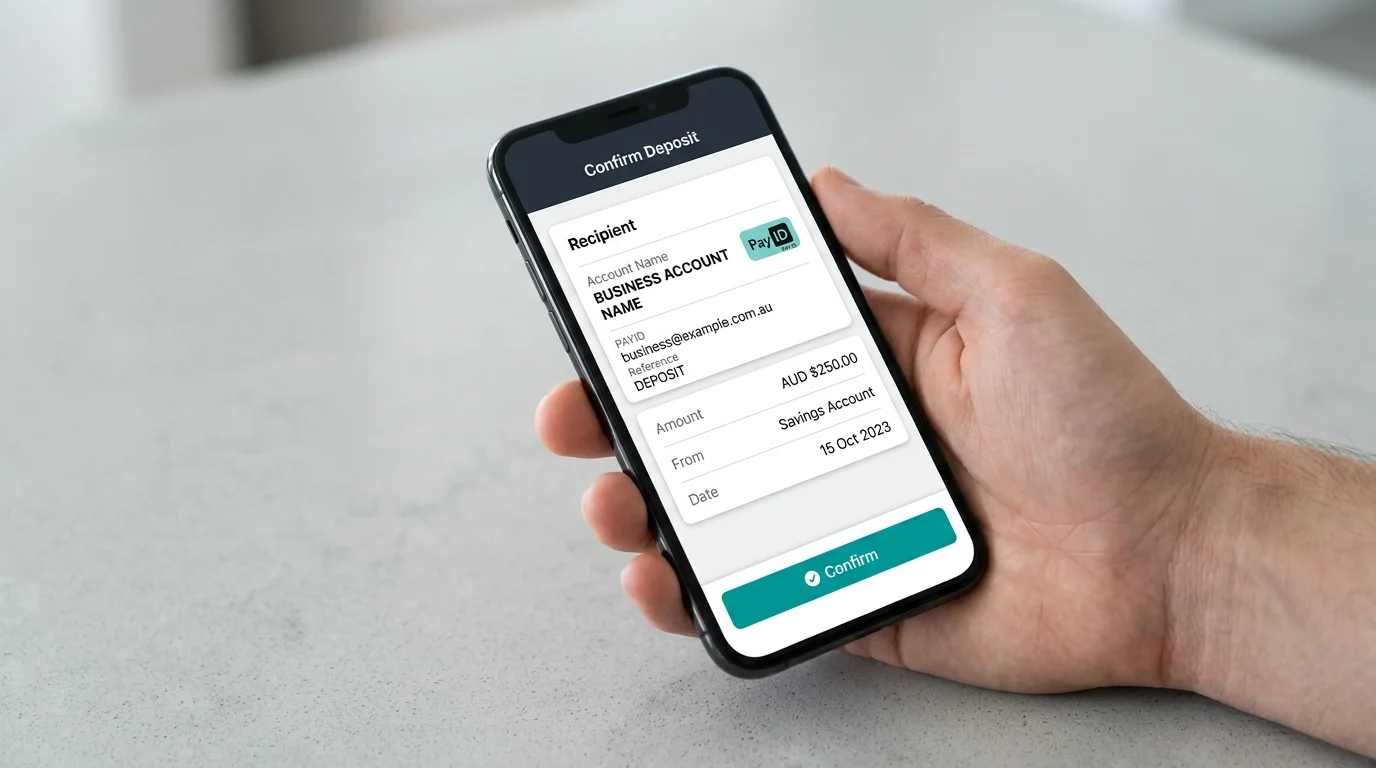
Open a new account using your legal name exactly as it appears on the bank account you will deposit from. Not a nickname, not a username. The downstream system that checks PayID name-match is unforgiving — "Jim" in the casino account against "James" on the bank record will trigger a hold of 24–72 hours through manual support.
Navigate to the cashier, select PayID, and read the alias the operator displays. Most operators publish a unique phone number per session; some publish a generic email alias. Copy the one shown on this attempt, not one from a previous deposit.
Open your banking app, hit "Pay Someone", paste the alias, and pause before confirming. The bank's lookup returns the registered name on the destination PayID. Verify against what the cashier displays. If it does not match — different company name, missing letters, unfamiliar payment processor brand — close the flow immediately. That is a scambling check telling you something important.
Confirm the amount, authenticate with biometrics or PIN, and watch the cashier. Most operators credit within twenty seconds. Beyond two minutes, the deposit is in some kind of trouble — message support before doing anything else.
Before your first deposit
- Confirm your PayID daily limit inside the banking app — the default A$1,000–A$2,000 will reject larger balances, and raising the cap takes under a minute
- Match every field across systems: name on bank account = name on casino account = name on ID, character for character
- Prepare the KYC pack — driver licence or passport photo, proof-of-address document under three months old, screenshot of the bank-side PayID confirmation
- Verify the operator's licence seal is a live link to the regulator's database, not a static image
- Take a screenshot of the bank's confirmation with timestamp visible
One safety note about the biometric prompt. The fingerprint or face ID confirmation should appear exclusively inside your banking app — never on the casino cashier, never on a third-party "verify your identity" overlay. Any biometric prompt outside your bank app is not your bank. It is somebody else's interface trying to look like your bank.
Anatomy of a PayID Withdrawal
The hardest sentence to write honestly in this niche is the one about withdrawal speed. Deposits clear in under a minute — true on every PayID-accepting operator I have tested. Withdrawals are a different story, and the gap between marketing claims and actual benchmark data is wide enough to be a scandal.

The mechanics. You request a payout naming a PayID alias attached to your own bank account. The operator's risk engine flags it for auto-approval (returning customer, clean history, KYC complete) or manual review (first withdrawal, anomalous patterns, unfinished KYC). Real numbers cluster around 2–8 hours for subsequent withdrawals, 4–24 hours for the first. After approval, the rail leg is near-instant — twenty seconds, maybe ninety on a slow batch.
Two pieces of friction concentrate on the first withdrawal: initial KYC if it sits unfinished, and a soft fraud overlay where the first outbound to a new alias goes through manual treasury check — 30 minutes to 12 hours depending on staffing. Subsequent withdrawals usually skip both.
The published "less than 24 hours" timing is easy to misread. It measures approval to bank credit, not request to bank credit. When you see a "10-minute withdrawal" claim, ask whether that is from request or from approval — the answer matters by a factor of ten.
Where the rail genuinely shines is on the second and third withdrawal. Once your KYC pack is locked in, payouts compress quickly — 30 minutes to 2 hours is realistic, sub-10 minutes recorded on weekday afternoons at well-run operators.
Median approval-to-credit
Under 24 hours at top-tier operators; 0–4 hours at the fastest.
Fastest verified payout
6 minutes from approval to CommBank credit, on a second withdrawal mid-week.
First-payout KYC window
4–24 hours typical, depending on document review staffing.
Weekend treasury lag
8–16 hours longer than weekday median at operators that batch outside business hours.
Weekend behaviour deserves a warning. The NPP runs 24/7. Most offshore operator treasury teams do not. A withdrawal requested at 6 p.m. AEST on Friday at an operator that batches payouts can sit until Monday regardless of how clean your KYC is. For the operator-level breakdown, the fastest payout operators we tested get measured every quarter on a six-payout benchmark per site.
The Numbers That Actually Bind Your Cashier
There is no PayID fee. None of the Big 4 banks charge to send a payment over the rail; offshore operators do not charge to receive one. That sentence carries weight in this niche — almost every alternative payment method takes a slice on the way in or out. PayID is genuinely zero-fee in both directions.

What does bind you is limits, on three layers. The bank sets a daily ceiling; the casino sets a per-transaction floor and ceiling; the rail imposes nothing. The friction is human policy, not technology.
On the bank side, defaults are conservative. Most Australian retail customers sit at A$1,000–A$2,000 per day on PayID outbound until they raise the cap. CommBank, NAB and Westpac let you push the daily limit up to A$25,000 entirely in-app; ANZ caps the in-app increase at A$20,000. Higher amounts require a phone call.
On the casino side, minimums begin at A$10 at the most accessible operators and stretch to A$30 at restrictive ones. Per-transaction maxima sit between A$5,000 and A$20,000 depending on the operator's PSP. For a five-figure deposit, message support first — your bank's daily limit and the operator's per-transaction cap need to align.
| Layer | Typical limit | Upper bound | Fee |
|---|---|---|---|
| Bank default | A$1,000–A$2,000 daily | App-raisable in under a minute | Nil |
| Big 4 in-app raise | A$20,000–A$25,000 daily | Phone-call increase available | Nil |
| Casino minimum | A$10–A$30 per deposit | Fixed by operator | Nil |
| Casino per-transaction max | A$5,000–A$20,000 | Fixed by PSP | Nil |
| NPP technical ceiling | No formal cap | Effectively unlimited | Nil |
The interesting layer is not the absolute ceiling — it is the velocity. The bank's fraud overlay watches patterns: three deposits in ten minutes, totalling around A$8,000, will trigger a soft block at most Big 4 banks even when no individual transaction is anywhere near the daily limit. The block is your bank protecting your account from a pattern that looks like account takeover. Your only recourse is the fraud team — a 10-minute call to verify identity and clear the hold.
If a cashier displays a "processing fee" attached to a PayID deposit, that fee is the operator's policy, not the rail's. An operator charging PayID fees is choosing to do so, and that choice is worth treating as a vetting flag.
The Bonus Stack You Will Actually Meet
The number that matters in a casino bonus is never the headline. A "A$5,000 welcome bonus across four deposits with 35x wagering" tells you almost nothing about whether you would see any of that money in cashable form. The mechanics underneath determine whether the figure is real, partly real, or theatrical.

Five bonus types repeat across the market. The welcome match is most common — a percentage of your first deposit credited up to a cap, locked behind wagering. The no-deposit bonus is rarer, a small credit given on registration, also wagering-locked and capped at small max cashout. Free spins are a variant of either, as packages on specific slot titles. Cashback returns a percentage of net losses as bonus-locked credit. VIP or loyalty bonuses sit on top, accruing on play volume.
The mechanic that turns any of these from theoretical to cashable funds is the wagering requirement. A 35x requirement on a A$200 bonus means A$7,000 of total bets before the bonus and any winnings convert to withdrawable funds. Game weighting decides how much each bet counts: pokies usually 100%, live blackjack often 10%, live roulette frequently 0%. Max-bet rules during wagering (typically A$5 or A$10 per spin) can void the bonus retrospectively if violated. Time windows compress the schedule into a deadline most players do not reach in time.
A working example, no operator named: a A$200 welcome bonus at 35x wagering, restricted to pokies at 100% contribution and live games at 10%, with a 30-day clearance window. Pure-pokies clearance: A$7,000 of bets. Pure live blackjack clearance: A$70,000 in 30 days. The structure is mathematically identical; the practical outcome is not even close.
What PayID does with bonuses is essentially nothing. The deposit method does not usually unlock or restrict bonus eligibility on a well-run operator. The bonus economics live in the wagering rate, the game weighting and the max-bet rule, not in the rail you used.
For the wagering arithmetic, max-bet rules, and the difference between sticky and non-sticky bonus mechanics, the full bonus mechanics breakdown is where I keep the working math current.
Scambling, Spoofs and How Money Disappears
The single most dangerous misconception in this niche is that a fast-looking website with a PayID alias is automatically a casino. Sometimes it is a scam dressed as one — what AUSTRAC has formally named "scambling", and what cost Australian players an unreported but rising amount through 2025.

Brendan Thomas, who runs AUSTRAC, described the pattern bluntly at the Regulating the Game conference in 2025: "We're seeing a rise in so called 'scambling', where unlicensed online gambling platforms advertise on social media and trick people to visit a scam website to participate in gambling. Players are then asked to deposit funds into a PayID but it's highly unlikely they will ever see their winnings from these sites." The architecture is deliberately thin — a landing page with slot images, a registration form, PayID as the only deposit method, a chat widget pushing larger deposits.
Why PayID specifically? Card networks tag online gambling transactions with merchant category code 7995, and Australian banks block credit card transactions to MCC 7995 merchants under the post-2024 rules. The NPP has no MCC concept. A PayID outbound to a "Pty Ltd" alias does not look like a gambling transaction on the bank's risk overlay — it looks like a person-to-person transfer. The Fintel Alliance named PayID as the channel of choice for scambling because the rail bypasses MCC 7995 controls.
The visible flags are consistent enough to memorise. The domain is usually under six months old (WHOIS answers this in twenty seconds). No licence link in the footer — only a static "Licensed in Curaçao" badge. PayID is the only deposit method, or PayID alongside one obscure crypto option. Support chat opens unprompted and pushes urgency. The bank lookup on the PayID alias returns a generic company name that does not match the operator brand. Any one is suspicious. Two together is conclusive.
Genuinely offshore-but-real operators have a different texture. They have been around for years, the licence link goes through to the regulator's verification database, the cashier offers PayID alongside three to five other methods, support is reactive rather than aggressive. The distinction between an unlicensed-in-Australia operator (illegal under the IGA but operating in good faith) and a scambling operation (illegal and a pure exit scam) is not fine.
What scambling actually does to your money. The deposit clears in seconds, the casino balance updates, you play for a session, request a withdrawal — and the withdrawal request enters a status loop. "Pending review" becomes "additional KYC required" becomes "compliance team will contact you" becomes silence. The operator never had the AUD reserves to pay anyone out — the deposit was extracted to a money mule chain within hours. NPP recall through your bank is theoretically possible but practically rare on transfers older than 24 hours.
If you suspect a scambling site, the order of operations is your own bank first (request an NPP recall while the trace is fresh), then Scamwatch, then a formal ACMA complaint. The bank is your only realistic shot at recovery. The full diagnostic flow sits in the complete safety audit framework.
PayID Among Its Rivals on the AU Cashier
Five years ago, an Australian player's cashier had cards, crypto, POLi, Neosurf, BPAY, bank transfer and PayID side by side, all functional. That list has been pruned to three live options for offshore play in 2026 — PayID, Neosurf, and the occasional bank wire — with crypto sitting in a regulatory grey zone that varies by operator and jurisdiction.
PayID is the default real-time choice. It moves AUD between Australian retail bank accounts in under a minute, sits at zero fee on both ends, and runs 24/7 on a rail technically incapable of taking a weekend off. The trade-off is the trace — every deposit and withdrawal is fully visible on your bank statement, and your bank may flag patterns even when no individual transaction breaches a rule.
Neosurf is the prepaid voucher alternative — bought in cash at a newsagent, redeemed via 10-digit code at the cashier. Anonymous on deposit, capped at A$500 per voucher, and strictly one-way: there is no Neosurf withdrawal.
Crypto at offshore operators is complicated in 2026. The 2024 prohibition targeted onshore licensed operators directly; offshore operators sit outside that specific provision but inside broader ACMA enforcement. Most still accept crypto because the rail cannot be blocked at the bank level. Sub-10-minute settlement, but with price volatility, on-chain fees, and KYC complexity that PayID does not impose.
Conventional EFT — not NPP, the older settlement rail — is the legacy fallback. Slow (1–3 business days), usually free, fully traceable. Almost nobody uses it for deposits because PayID does the same job in a minute. It survives as a withdrawal option at older operators.
| Method | Speed | Fees | AUD-native | Withdrawal-capable | Trace level |
|---|---|---|---|---|---|
| PayID | Under 60 seconds deposit | Nil | Yes | Yes | Full bank statement |
| Neosurf voucher | Depends on retail purchase | 0–7% issuer fee | Yes | No | Cash-purchase visible only |
| Crypto | Sub-10 minutes | Variable network fee | No, with FX risk | Yes | On-chain, pseudonymous |
| Bank transfer EFT | 1–3 business days | Often nil | Yes | Yes | Full bank statement |
These methods optimise for different things: PayID for speed, Neosurf for anonymity at small amounts, crypto for cross-border movement, EFT for legacy compatibility. Most Australian players settle on PayID for everything until they hit a use case one of the others actually solves. For a rail-by-rail breakdown, the deep comparison of every payment rail is where the working table lives.
BetStop, Self-Exclusion and the Boring Stuff That Saves People
This is the section I rewrite most. Not because the facts change quickly — they do not — but because every player I have spoken to who lost more than they could afford had walked past the same warnings I am about to recite. Warnings work better described than pasted in as a closing disclaimer.

BetStop is the National Self-Exclusion Register, launched in August 2023 under ACMA oversight. It has one feature that voluntary operator-level programs structurally cannot offer: once you register, every Australian-licensed wagering operator is legally required to refuse you service, and the registration cannot be reversed for the duration you chose. By the close of Q1 FY 2025–26, 49,382 Australians had registered since launch. By the end of March 2026, that figure had climbed to nearly 60,000.
Two things matter for PayID casino players. First, the register covers Australian-licensed operators — sportsbooks, lotteries, on-course bookmakers — and does not reach offshore casinos, because those are illegal regardless of self-exclusion status. The protection is real but jurisdictional. Second, the most popular self-exclusion duration in recent quarters has been the lifetime option, chosen by 39 per cent of registrants in Q1 FY 2025–26. People are not registering casually — the most common choice is the permanent one.
The harm data underneath matters. ANU POLIS research recorded risky gambling rising from 13.7 per cent of participants in 2024 to 19.4 per cent in 2025, while total participation slightly declined. The product mix is shifting toward online and higher-volatility formats — the harm metric is climbing while the headline number falls.
Practical tools that work better than willpower. Deposit limits set inside the operator's cashier (most offshore operators offer them despite no requirement to), session timers, self-exclusion at the operator level as a stopgap before formal BetStop registration, and Gambling Help Online for direct counselling. None of these are PayID-specific. The deposit rail does not cause harm; the volume of play and the velocity of deposits do.
Where this lands: if you find yourself raising your bank's daily PayID limit specifically to deposit more at an offshore casino, that is the signal worth attending to. The technical capability of the rail has expanded faster than the regulatory protection around it. The protection you have left is the one you build for yourself — before the second deposit, not after the seventh.
Questions Players Send Me Every Week
What exactly is a PayID casino and how does it work?
A PayID casino is shorthand for an offshore online casino that accepts deposits and pays withdrawals over Australia's New Payments Platform, using a PayID alias as the destination identifier. The rail is owned by Australian Payments Plus and supervised by the RBA. The casino itself sits offshore, typically licensed in Curaçao, Anjouan or Costa Rica. Deposits clear in under a minute; withdrawals run the same rail in reverse, with the operator's KYC and treasury approval adding the lag.
Are PayID casinos legal for Australian players?
The Interactive Gambling Act 2001 prohibits offshore operators from supplying interactive gambling services to Australian residents. The operator is breaking the law — no criminal liability falls on the player who deposits. Practically: no prosecution risk, but no legal recourse against the operator either. PayID itself, as a banking service, is fully lawful for any payment purpose.
Is depositing through PayID at a casino safe?
The rail is safe — PayID is a regulated Australian banking service with bank-grade security and full statement traceability. The operator on the other end is the variable. A genuinely offshore-but-real casino with a clickable licence link and a multi-year payout history is safe in the same sense an offshore site can be. A scambling operation dressed as a casino is not, and looks similar at first glance. Verify the licence link, check the WHOIS age, and run the 3 a.m. support test.
How long do PayID deposits and withdrawals take?
Deposits clear in under sixty seconds at every PayID-accepting operator I have tested. Withdrawals are bimodal: the NPP rail leg is near-instant, but operator-side approval consumes the time. First withdrawals typically take 4–24 hours because of initial KYC and a manual fraud overlay. Subsequent withdrawals run substantially faster — 30 minutes to a few hours, sub-10 minutes at the fastest. Weekends can add 8–16 hours at operators that batch outside business hours.
What are the typical deposit and withdrawal limits at PayID casinos?
Three layers determine the practical limit. The bank sets a daily PayID outbound cap — A$1,000–A$2,000 default, raisable in-app to A$20,000 (ANZ) or A$25,000 (CommBank, NAB, Westpac). The casino sets minimums (A$10–A$30) and per-transaction maximums (A$5,000–A$20,000). The NPP rail itself imposes no technical cap. Velocity matters more than absolute limits — three deposits in ten minutes trigger bank-side fraud overlays even when each is well under the daily ceiling.
Which Australian banks support PayID for casino transactions?
PayID is supported by all four Big 4 banks — CommBank, Westpac, NAB and ANZ — along with more than a hundred other Australian financial institutions including most credit unions, mutuals and neobanks. The bank's role is identical regardless of which one you use: it sends or receives the NPP clearing message and credits the customer account at near-instant speed.
What should I do if my PayID casino deposit is declined?
Three causes account for almost every decline. First, the bank's daily limit — raise the cap in-app, retry. Second, name mismatch between bank and casino accounts. Third, the bank's fraud overlay — repeated transactions or sudden velocity changes trigger a soft block that requires a five-minute call to the bank's fraud team to clear. The casino itself almost never declines a PayID deposit — declines are bank-side, virtually every time.
Where I Land on PayID Casinos for 2026
If there is one sentence to leave the page with, it is this: a "PayID casino" is not a regulated Australian product, and the rail you use does not change the operator you have chosen. The NPP is doing exactly what it was built to do — moving AUD in real time between Australian bank accounts, with bank-grade security and zero fees in either direction. The casino at the other end is a separate question with a separate answer, and the variable is where the risk concentrates.
What that means in practice. Verify the licence link before depositing. KYC up front, while you are not waiting on a payout. Complete your first withdrawal at the minimum amount before raising stakes. And remember that scambling sites look identical to real casinos until the moment they do not — which is usually the moment you click "Withdraw" for the first time.
PayID is a regulated Australian banking rail. The casino at the other end is not. Every word of practitioner advice in this guide hinges on that single distinction, and nothing in 2026 is likely to change it.
Prepared by the casinopayidau.com editorial staff.