If you walked into an Australian-facing online casino in early 2023 and looked at the deposit page, you’d see eight or nine viable payment options. Credit cards, debit cards, POLi, BPAY, Neosurf, several crypto rails, two or three eWallets, and sometimes PayID. By the middle of 2024 that shelf had collapsed to roughly three workable options, and PayID was the largest of them by a margin that’s still growing every quarter.
The collapse wasn’t gradual. It was a hard regulatory shove combined with one big commercial failure. The 11th of June 2024 made credit cards and crypto unusable for online wagering at the licensed-operator level, with penalties up to A$247,500 per contravention reshaping operator behaviour in months. POLi — the bank-account-pull rail that had been the easiest deposit method for Australians for a decade — shut down in 2023 under its own commercial pressures. Two strikes against the alternatives, one quiet rise for PayID.
This article walks through what’s actually on the deposit page in 2026, how each method compares with PayID head-to-head, and which one suits which kind of player. Spoiler — PayID wins on most axes because the alternatives can’t compete on speed or fee structure, but it loses on a couple where you might not expect it. Privacy is the obvious one.
The map of methods that survived into 2026
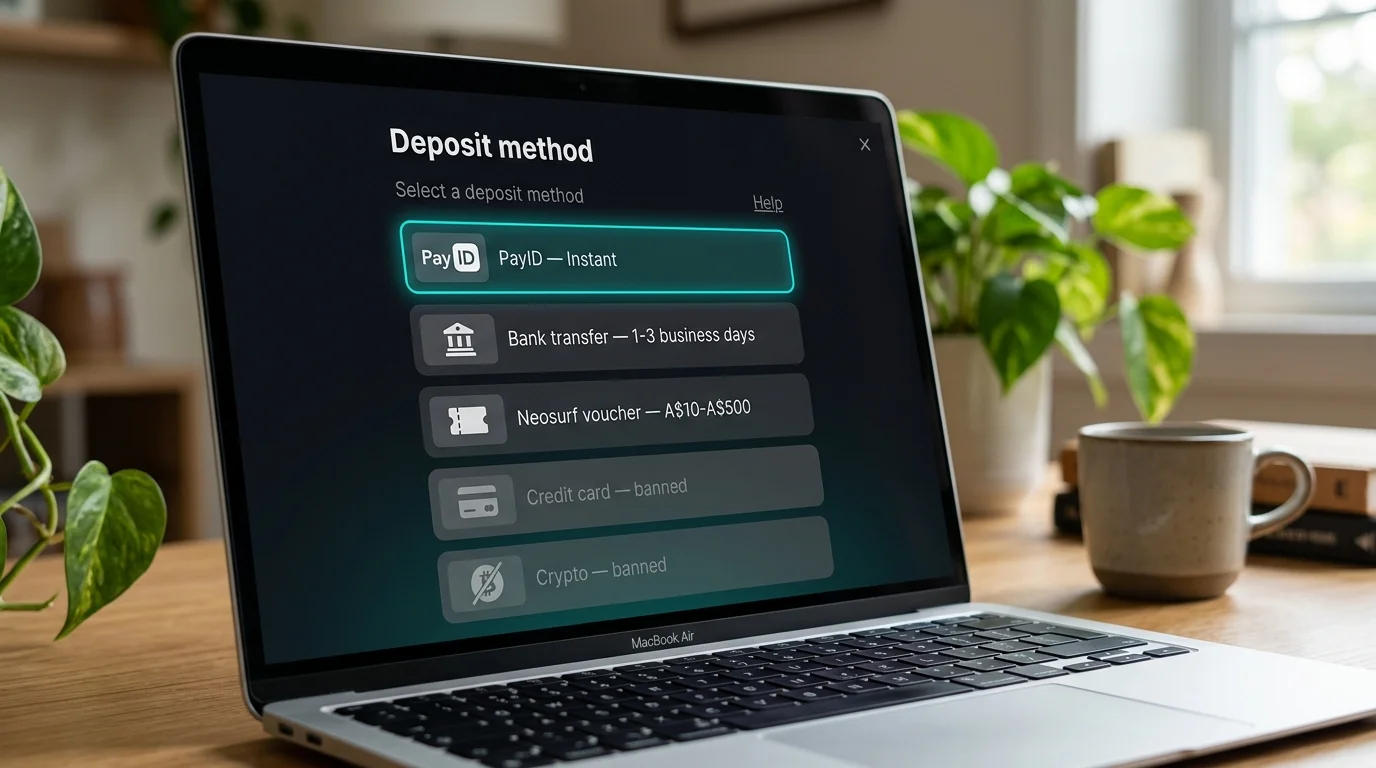
Here’s the actual landscape on a representative offshore casino deposit page as of mid-2026. PayID sits at the top, usually first or second in the list, often with a small “Instant” or “Recommended” badge. Bank transfer — the traditional kind, not NPP — sits below it, marked with a “1 to 3 business days” disclaimer that’s at least honest. Neosurf vouchers are usually third, sometimes second, with a clear cap at A$500 per voucher and only inbound functionality. After that you’ll see a thinning list: crypto on operators that ignore the licensed-sector ban (which is most offshore operators), occasionally an eWallet that hasn’t yet been pushed out by Australian de-risking, and on a few sites a still-functioning debit card option that survives on bank-by-bank tolerance.
The credit card and crypto bans on licensed online wagering — effective 11 June 2024 — don’t legally bind offshore operators, but they have second-order effects that compress what’s actually available. Australian banks now de-risk gambling-tagged transactions more aggressively, which means card transactions to offshore casinos increasingly fail at the bank-side block before they ever reach the operator. The MCC 7995 monitoring that AUSTRAC and the Big 4 are running picks up card-based casino transactions specifically. PayID transactions don’t carry that code, which is exactly why PayID has won.
“Our government takes seriously our responsibility to prevent and reduce harm from online wagering. Our ban on credit cards will help with this goal. You can’t use your credit card to place a bet for land-based gambling. Now the same rules apply for online gambling.” That’s how Amanda Rishworth, the minister responsible for the credit-card ban, framed the change at the time. The political framing was harm-reduction. The market effect was concentration onto whichever rails the banks weren’t actively monitoring. PayID was the obvious beneficiary.
The map I’d encourage you to keep in your head is this: PayID for normal play, bank transfer for amounts that exceed your daily PayID limit, Neosurf for the rare case where you want to deposit cash you’ve already withdrawn from an ATM. Everything else is either banned, broken or marginal.
PayID in five minutes if you’ve never used it for casinos
Before we compare PayID against anything, let me make sure we’re working from the same definition. The brand “PayID” is the consumer-facing alias layer on top of Australia’s New Payments Platform. You register an alias — a mobile number, an email address, or for businesses an ABN — and link it to a bank account. Anyone with your alias can then push you a real-time transfer without ever knowing your BSB or account number. The rail underneath is administered by Australian Payments Plus and clears in seconds at any hour of any day.
The Australian uptake is now substantial. PayID registrations passed 27 million by the middle of 2025, which is more than the entire adult population of the country if you count individuals who’ve registered multiple aliases against different accounts. Over 100 financial institutions support PayID, including all the Big 4 banks and most credit unions and mutuals. The rail itself sees roughly 120 million NPP transactions every month, of which a steadily growing share are PayID-aliased.
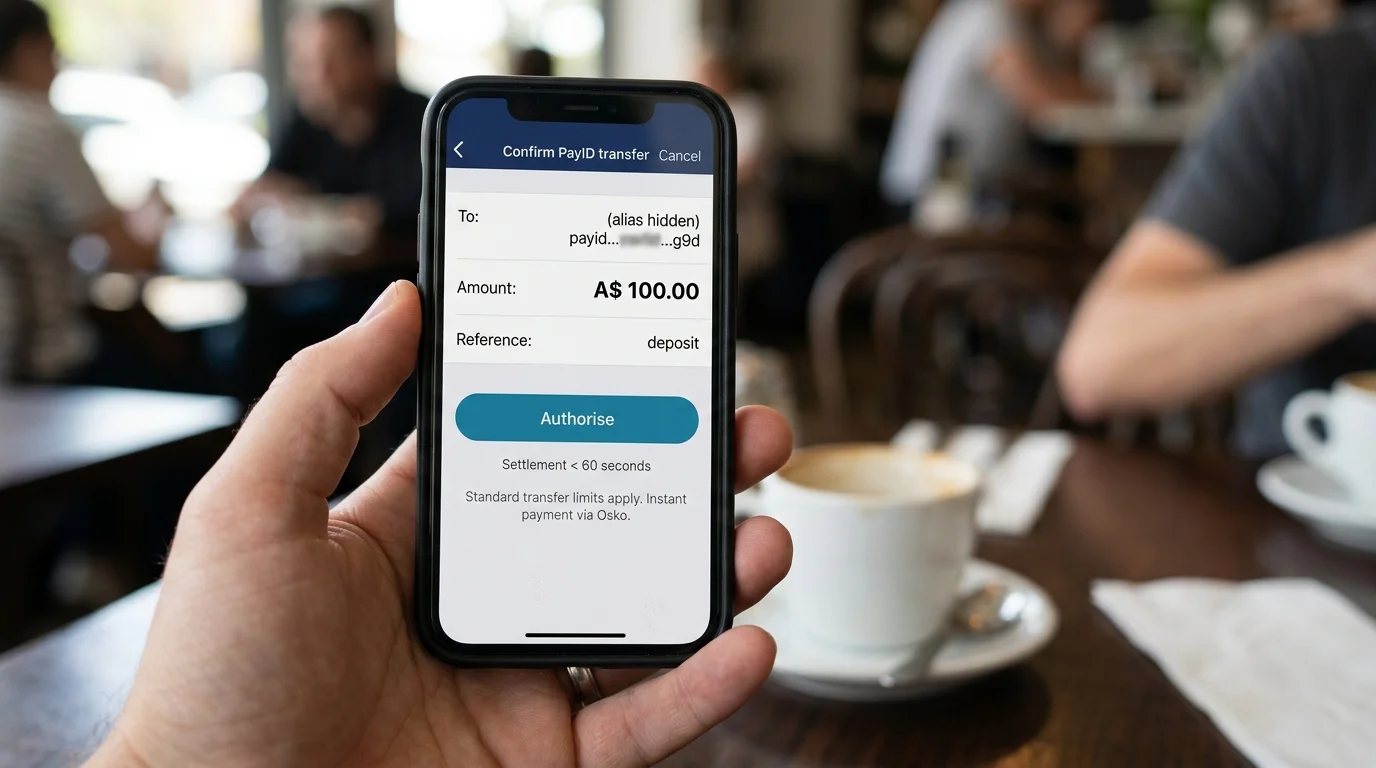
For casino use specifically, the relevant mechanics are these. You enter the operator’s PayID alias into your banking app, confirm the transfer amount, authorise it via your usual bank-app authentication (typically Face ID or fingerprint plus a passcode), and the funds land in the casino’s cashier in under 60 seconds on the median test, sometimes in well under 10 seconds. Withdrawals at competent operators clear in under 24 hours after KYC completion, often much faster. No transaction fee at either end, no currency conversion since everything is AUD, no card-network friction.
That’s the five-minute version. Now let me compare it against everything else still on the deposit page.
PayID against the card methods that used to dominate
Cards used to be the default. Visa, Mastercard, the occasional Amex on big-brand casinos — fast at deposit, slow at withdrawal, manageable on fees. From 11 June 2024 onward, credit cards became prohibited for online wagering at licensed Australian operators. Offshore operators technically aren’t bound by the ban, but the bank-side effects have compressed card usability dramatically.
Debit cards still work intermittently at offshore casinos. Whether your specific debit transaction goes through depends on which bank you’re with, which operator you’re depositing at, what amount you’re sending, and whether your particular transaction trips the bank’s gambling-related MCC monitoring. In my own testing across 2025 and 2026, debit card deposits to offshore casinos failed at bank-side block rates of around 40 to 70 per cent depending on the issuer. CommBank and ANZ run the most aggressive blocking, NAB and Westpac slightly less so, mutuals very variably.
Even when a debit card deposit clears the bank, the operator-side speed is comparable to PayID at deposit time — both land within a minute or two — but withdrawals are where the gap opens. Card refunds back to the originating card take 2 to 5 business days. PayID withdrawals at competent operators clear in under 24 hours. So for any player intending to actually cash out, PayID is straightforwardly faster.
The fee story tilts the same way. Card transactions to offshore operators frequently incur a foreign-transaction fee (3 per cent) and sometimes a cash-advance fee (another 2 to 5 per cent for credit cards, though that’s now moot under the ban). PayID transactions are free at both ends. On a A$300 deposit, the card path costs you A$9 to A$24 in fees before any gambling outcome. PayID costs you nothing.
The card vs PayID question essentially settles itself in 2026. Cards are functionally on their way out for this use case.
PayID against Neosurf vouchers
Neosurf is the strangest survivor on the 2026 deposit page. It’s a prepaid voucher system — you buy a Neosurf voucher at a participating Australian retail outlet (newsagent, convenience store, some petrol stations) for an amount between A$10 and A$500, get a 10-digit code, and enter that code in the operator’s cashier as your deposit. The deposit lands instantly, with zero linkage to your bank account at the casino end.
For privacy-prioritising punters, Neosurf has a genuine advantage that PayID can’t match. The operator sees a voucher code, not your name. The bank-side trail starts and ends at the retail purchase, which is generally cash. From the casino’s perspective, your deposit has no banking-system identity attached. That’s a real feature for people who want to keep their gambling activity off their bank statements, even if their reasons are perfectly legitimate (privacy from a household partner, for example).
The big structural limit is that Neosurf is one-directional. You can deposit with a voucher, but you can’t withdraw to a voucher. Operators that accept Neosurf for deposit typically default to bank transfer or PayID for withdrawal, which means anyone who wins meaningfully with a Neosurf-deposited account has to provide bank details to receive their winnings anyway. The privacy advantage erodes the moment you cash out.
The other limits are practical. The A$500-per-voucher cap means anyone wanting to deposit larger amounts has to chain multiple vouchers, which gets fiddly fast. Vouchers carry a small markup at the point of sale — typically a few per cent of face value. And the retail-only purchase requires physical presence at a participating store during their hours. PayID, by comparison, is in your pocket 24 hours a day.
For an in-depth comparison of the exact use cases where Neosurf still beats PayID on specific metrics, including the privacy mechanics and the operator-coverage differences, see the full PayID vs Neosurf deep dive. The short version for this article: Neosurf is the niche choice for one-shot privacy-sensitive deposits, PayID is the general-purpose default for everything else.
PayID against crypto, which technically isn’t on the menu
Crypto for online wagering has been prohibited at the licensed-operator level in Australia since the same 11 June 2024 cutover that knocked credit cards out. Offshore operators ignore the ban on a structural basis — the licensing regime that binds Australian operators doesn’t reach them — so crypto is still technically a deposit option at most offshore casinos. Whether it’s a workable option is a different question.
The bank-side de-risking of crypto on-ramps in Australia has tightened steadily through 2025 and into 2026. Buying Bitcoin, Ethereum, or stablecoins from an Australian bank account routes through exchanges that are increasingly cautious about onward transactions to gambling-flagged wallets. The trip from “AUD in your bank account” to “BTC in the casino’s deposit address” now involves more friction, more KYC at the exchange end, and more transaction surveillance than it did in 2022.
Once the funds are in crypto, the on-chain transfer to a casino is fast (a few minutes for Bitcoin, faster for layer-2 alternatives) and the fees are typically lower than card fees were. But the volatility risk is structural. If you deposit A$200 worth of Bitcoin and the Bitcoin price moves 4 per cent in either direction in the hour between purchase and deposit confirmation, your effective deposit value moves with it. PayID transfers the actual Australian dollar amount you typed — no volatility, no settlement risk.
The withdrawal side is where crypto sometimes regains an advantage. Crypto withdrawals can be requested in amounts that exceed any local PayID bank-side daily limit, and they settle to your wallet within hours. But then you have to convert back to AUD through an exchange that’s running KYC on the reverse leg, and the round-trip costs in fees and slippage usually wipe out the apparent speed advantage. For routine play, PayID is simpler, cheaper and slightly faster. For genuinely large wins above standard PayID limits, crypto withdrawal is occasionally a workable second-leg solution, with all the bank-side scrutiny that follows.
PayID against POLi, which technically isn’t anywhere
POLi deserves a section of its own because punters still ask me about it in 2026 and it’s been gone for three years. POLi was a bank-account-pull rail — you’d enter your bank login credentials on a POLi-facing page, POLi would log in on your behalf, and it would pull funds directly from your account to the merchant. Fast, free, and a security model that gave bank security teams nightmares for years before the service finally shut down in 2023.
The closure had multiple causes layered on top of each other. Major Australian banks had been actively discouraging customers from using POLi for years, and CommBank had blocked it outright at various points. The Open Banking framework, by giving authorised data and payment access through a regulated API rather than through credential capture, removed POLi’s underlying justification. The operating company’s commercial position couldn’t survive the combination, and the lights went off in 2023.
What replaced POLi for the average Australian was effectively PayID. The two services solve overlapping problems — fast bank-account-to-merchant transfers without card-network mediation — but PayID does it through the proper banking-rail infrastructure (NPP) rather than through credential capture. Speed is comparable at deposit, fees are zero for both (POLi was free at the user end), and security is dramatically better at PayID’s end.
The historical detail matters because it explains the shape of the current market. PayID didn’t have to fight POLi for the dominant deposit-rail slot. POLi vacated the slot in 2023, the credit card ban arrived in 2024, and PayID inherited an empty kingdom largely by default. If POLi had still been running in 2024, the competitive dynamic on the deposit shelf would look quite different. As it stands, PayID is the only fast, free, bank-rail option in the market.
PayID against the older bank transfer rail
Conventional bank transfer — the kind that runs through the BECS clearing system rather than NPP — is still an option at most offshore casinos, and it’s the relevant comparison for anyone whose PayID daily limit isn’t sufficient for the amounts they want to move. The structural differences are easy to summarise: BECS is slow, PayID is fast, and that’s almost the entire story.
A conventional bank transfer to an offshore casino takes 1 to 3 business days to settle in the operator’s cashier. Same-day might happen if you initiate the transfer early on a business day and the receiving bank’s clearing cycle catches it; more often you’re looking at next-day or the day after. Weekends and public holidays add to that — BECS doesn’t process on non-business days. So a Friday-evening conventional transfer can sit until Tuesday before it lands.
The fee structure on conventional bank transfer to offshore is also worse. Domestic Australian transfers via BECS are free at the bank end, but offshore destinations frequently route through international transfer mechanisms that carry SWIFT fees (A$20 to A$30 per transfer) and intermediary-bank cuts. The total cost on a A$500 deposit via conventional transfer can be A$25 to A$40 in fees before any FX consideration. PayID costs zero.
The case for conventional bank transfer comes down to amount size. PayID daily limits at most Big 4 banks cap at A$25,000 per day when raised through the banking app; ANZ caps at A$20,000. For deposits beyond those limits in a single transaction, conventional bank transfer becomes the only option. For everything below those limits — which is essentially every realistic casino deposit — PayID wins on every axis that matters.
Speed as a side-by-side comparison
I’ve talked about speed in every section so far, so let me put the numbers in one place where they can be compared at a glance. The NPP rail itself moved almost 2 billion real-time payments across Australia in 2025 — the volume is real and the rail is uncongested for the kinds of amounts we’re talking about. So PayID’s deposit speed is essentially the speed of the rail itself.
Method
Deposit time
Withdrawal time
Daily limit
Anonymity at operator
PayID
Under 60 seconds
Under 24 hours after KYC
A$20,000 to A$25,000
Low (name + alias visible)
Conventional bank transfer
1 to 3 business days
1 to 3 business days
Bank-determined
Low (full bank details)
Neosurf voucher
Under 5 minutes
Not supported
A$500 per voucher
High (voucher code only)
Debit card
1 to 5 minutes
2 to 5 business days
Bank-determined, often blocked
Medium (card details)
Crypto
5 to 30 minutes
Under 1 hour to wallet
None at operator end
Medium (wallet address)
Read the table by what matters to you. Speed-prioritising punters land on PayID for any normal amount. Privacy-prioritising punters land on Neosurf for the deposit half and accept a separate-method withdrawal. Large-amount punters use conventional transfer or crypto for the legs that exceed PayID limits. There’s no universal winner, but for the middle 80 per cent of use cases — A$50 to A$5,000 deposits, normal play, ordinary cashouts — PayID outscores everything else on the table by a margin that doesn’t really require a table to demonstrate.
Privacy as a side-by-side comparison
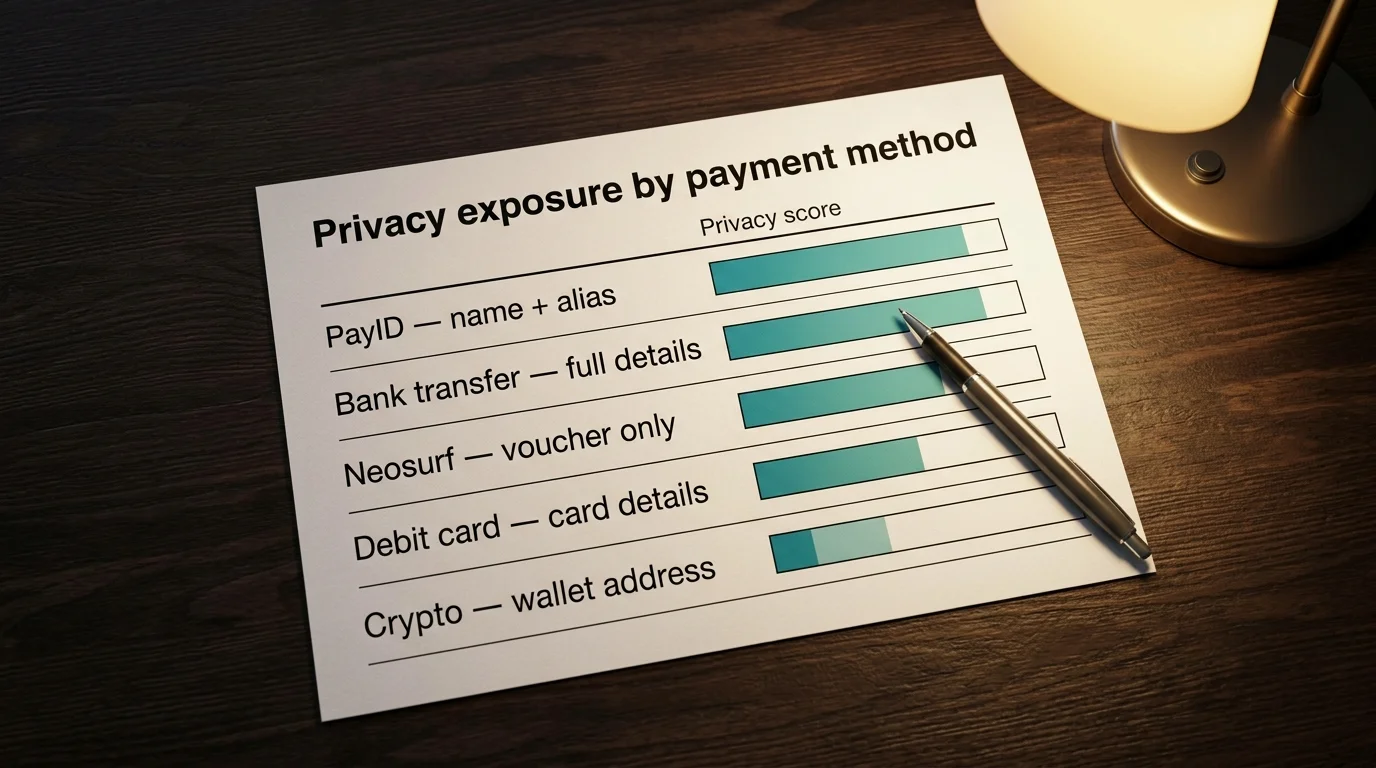
Privacy is the one axis where PayID measurably loses ground to some alternatives, and it’s worth being honest about that because most reviews don’t bring it up. Each payment method exposes a different bundle of personal data to the casino operator, and the differences matter if your reasons for keeping gambling activity private are real.
PayID transfers expose your registered name on the bank account and your PayID alias to the operator. The alias is whatever you registered — typically your mobile number or your email address. Once you’ve deposited, the operator has a confirmed mapping between your casino account identity and your real-world bank-side identity. This is fine for the legitimate operator and uncomfortable for any operator you don’t fully trust.
Conventional bank transfer exposes even more — your name, your account number, your BSB. The operator’s receiving bank knows the full origin of every deposit. This is the lowest-privacy method on the list.
Neosurf vouchers expose almost nothing to the operator — just the voucher code, which has no banking-system identity attached. The operator may still require KYC documents to process a withdrawal, but the deposit itself is essentially anonymous from their perspective.
Debit card transactions expose card-number-derived data, which the operator stores as a tokenised reference and which can be cross-referenced through the card network. Less granular than full bank-account exposure, but more than Neosurf.
Crypto transactions expose a wallet address, which is pseudonymous rather than anonymous. Blockchain analysis tools can de-anonymise wallet activity if your purchasing exchange ran KYC on you (which all Australian-licensed exchanges do). So crypto looks more private than it actually is, particularly for retail Australian users.
The headline finding: if privacy is your top priority, Neosurf wins for deposits and you accept the withdrawal-method tradeoff. If privacy isn’t a deciding factor, PayID’s slight exposure cost is dwarfed by its speed and fee advantages.
Which method actually suits which kind of player
Every payment-method comparison ends with some version of “it depends” and most reviewers leave it there. That’s lazy. Let me do the actual matching for the four player profiles that account for almost everyone who’s reading this.
The casual punter. Deposits A$30 to A$100, plays a few sessions a month, occasionally cashes out small amounts. PayID is the obvious match. No fees, fast deposits, fast withdrawals, no daily-limit pressure at these sizes, no need to think about it. The casual punter who tries to optimise their payment method beyond PayID is over-engineering a small problem.
The weekly regular. Deposits A$100 to A$500 across two or three sessions a week, has a relationship with one or two operators, treats it as a hobby budget rather than an occasional indulgence. PayID is still the best general-purpose match, but the weekly regular benefits from also having a backup method available — typically Neosurf for the occasional privacy-prioritised session, or a debit card kept ready for the rare day when PayID hits a temporary bank-side block. The weekly regular’s optimum is a primary PayID with a backup.
The high-roller. Deposits A$1,000 to A$10,000 per session, regular cashouts in the A$5,000 to A$30,000 band. PayID handles deposits comfortably up to the Big 4 daily app-raised limits (A$25,000 at CommBank, NAB and Westpac; A$20,000 at ANZ), but bumps the ceiling for single transactions above those limits. The high-roller’s playbook is PayID for the deposit and the regular cashout, conventional bank transfer for the occasional large cashout that exceeds daily limits, and a working understanding of which Big 4 has the most permissive daily limit for their account history.
The privacy-first player. Doesn’t want gambling activity visible on their bank statements, for any of a dozen perfectly legitimate reasons. PayID is structurally not their friend — bank statements show the operator-side identity in the transaction description. The privacy-first player uses Neosurf vouchers for deposits and accepts the inconvenience of voucher purchases at participating retailers. Withdrawals, when they’re needed, route through whatever method the operator offers, with the understanding that the privacy advantage is one-directional.
Matching method to player profile is more useful than picking a universal “best”. PayID wins three of four profiles. Neosurf wins the fourth. That’s the honest comparison.
What the comparison adds up to
The 2026 deposit shelf has effectively two methods worth taking seriously for offshore casino use. PayID is the general-purpose default — fast, free, well-regulated on the rail side, capable of handling deposits and withdrawals up to limits that suit most punters. Neosurf is the privacy-niche option that exists for the small fraction of users whose top priority is keeping the deposit off their bank statement, and who accept the one-directional limitation.
Everything else on the page is legacy, transitional or marginal. Cards are functionally being squeezed out by bank-side de-risking. Crypto carries volatility and on-ramp friction that wipes out its apparent advantages. POLi is gone. Conventional bank transfer is workable but slow and fee-heavy.
The honest tradeoff PayID asks of you is mild privacy exposure to the operator in exchange for speed and zero cost. For most players that’s an easy trade. For some it isn’t, and Neosurf is the alternative. That’s the whole comparison.
Why did Australian casinos shift away from POLi after 2023?
POLi shut down in 2023 — it didn"t shift away on its own, it stopped existing. The operating company couldn"t sustain its commercial position once major Australian banks had been discouraging or blocking POLi credential-capture flows for years, and the rise of NPP-based alternatives like PayID gave consumers a faster, safer route to the same outcome. Operators moved to PayID because POLi was no longer running, not because they actively preferred PayID at the time.
Is PayID actually faster than a debit card deposit at offshore casinos?
Marginally on deposit, dramatically on withdrawal. PayID deposits land in under 60 seconds; debit card deposits typically land in 1 to 5 minutes once they clear the bank-side block (which fails 40 to 70 per cent of debit-card attempts to offshore casinos in recent testing). PayID withdrawals clear in under 24 hours at competent operators; card refunds take 2 to 5 business days. The full round-trip is several days faster on PayID.
Does PayID expose more personal data to the casino than crypto would?
Yes, slightly. PayID exposes your registered bank-account name and your alias (usually mobile or email) to the operator. Crypto exposes a wallet address that"s pseudonymous but increasingly de-anonymisable through blockchain analysis if you bought the crypto from a KYC-running Australian exchange. So the apparent privacy gap is smaller than it looks — both methods leak identity, just through different channels. Neosurf is genuinely more private than either.
Can I still use Neosurf at AU-facing casinos in 2026?
Yes. Neosurf vouchers remain available for purchase at participating Australian newsagents, convenience stores and some petrol stations, in amounts from A$10 to A$500 per voucher, and most offshore casinos that accept PayID also accept Neosurf as a parallel option. The structural limit is that Neosurf is deposit-only — you can"t withdraw to a voucher — so winners using Neosurf for deposit have to cash out via PayID or bank transfer, which means providing banking details at the withdrawal stage.