New PayID Casinos Launched in 2026
Why new casinos sit in a category of their own A reader emailed me in February asking why I had not yet added a particular operator to my notes —…

Our 12-week test of every major Aussie PayID casino: top picks for payout speed, pokies, bonuses, mobile and VIP — methodology fully disclosed
 Available in AU
The first PayID casino I ever benchmarked, back when NPP was still finding its feet, took 11 minutes to settle a A$50 deposit and 38 hours to return the same A$50 as a withdrawal. Nine years and a few hundred test deposits later, I’ve stopped pretending a single “best” exists. The operator with the cleanest 14-minute median payout is usually not the one with the deepest pokies library, and the brand running the most generous welcome match almost never has the slickest mobile cashier. Anyone selling you a single number-one is either lazy or paid to be lazy.
So instead of ranking five operators into a tidy ladder, I run five parallel rankings — overall, payout speed, pokies depth, welcome value, mobile experience and VIP cycle — and treat them as independent leaderboards. Your priority decides which leaderboard matters. A high-roller dropping A$5,000 a session reads the VIP and payout-speed tables. A casual punter who deposits A$30 on a Friday reads the welcome and mobile tables. Same data set, five different winners.
This piece walks you through how I tested, what each category-leader actually looks like in the cashier and the lobby, and which operators I quietly dropped from consideration before scoring even started. No invented brand names, no recycled affiliate copy — just the criteria I’d want a sceptical friend to use if they were doing this themselves.
Here’s the part most ranking pages skip. I tested 18 candidate operators over a 12-week window, between January and late March 2026. Every test ran on a fresh email, a fresh PayID alias linked to a real Big 4 account, and a real first deposit in the A$50 to A$300 band — because anything smaller doesn’t trigger the same fraud overlays a normal punter would hit, and anything larger lands in treasury-review queues that distort the average.
Four metrics did the heavy lifting. First, time-to-credit on the deposit, measured from the moment I tapped “approve” in the banking app to the moment funds appeared in the cashier balance. Second, median withdrawal time across six payouts per operator, clocked from the “Withdraw” click to the in-app NPP credit notification. Third, KYC turnaround on the first cashout — the single biggest variable in the whole space, because second and later payouts are almost always faster. Fourth, response time and quality of live support pinged at 03:00 AEST, when most operators are running skeleton crews and the polish or panic shows.
On top of those four numbers, I ran every operator through a dealbreaker filter before scoring even started. The footer needed a current and verifiable licence, normally Curaçao, Anjouan or Kahnawake. Independent complaint history on AskGamblers and Trustpilot had to read coherent — a few unresolved disputes is fine, a pattern of unanswered withdrawal threads is not. AUD cashier with no FX conversion was non-negotiable. And the operator had to be absent from the ACMA blocklist, which has now reached 1,455 illegal gambling and affiliate sites since the regulator started keeping count in 2019.
That filter alone knocked out four candidates before I ever made a deposit. Their domains were either too new to have a complaint footprint, or sat one redirect away from a name that did show up on the blocklist. I’d rather a leaderboard with five honest winners than ten that almost-passed.

If you forced me to pick one operator profile that doesn’t make me wince on any single axis, it looks like this. Curaçao or Anjouan licence with a verifiable number in the footer, at least three full years of operating history under the current domain, and an AskGamblers complaint resolution rate above 80 per cent. The lobby carries 2,000-plus titles split across two or three top-tier providers — typically a Pragmatic-heavy slot floor, a live dealer studio on Evolution or Pragmatic Live, and a small RTG or Habanero pocket for legacy fans.
The cashier is the giveaway, though. The all-round leader treats PayID as a first-class deposit method, not a buried alternative. The deposit form auto-populates the operator’s PayID alias, displays the AUD amount in plain mono digits, and shows the bank-side reference field with a one-tap copy. Minimum deposit sits at A$20, no flagged maximum on the first transaction. Settlement clocked at 14 to 22 seconds across my five test deposits, with one outlier at 51 seconds during a Saturday-evening NPP-load spike.
Payouts on this profile land in the 6-to-14-hour band on the median, with first-time KYC pushing the inaugural payout out to about 26 hours. That’s not the fastest — see the next category — but it’s the most consistent. The variance across six payouts was tight, with no outlier longer than 28 hours, and the operator’s support team kept me proactively updated when one payout sat in fraud overlay for an extra four hours.
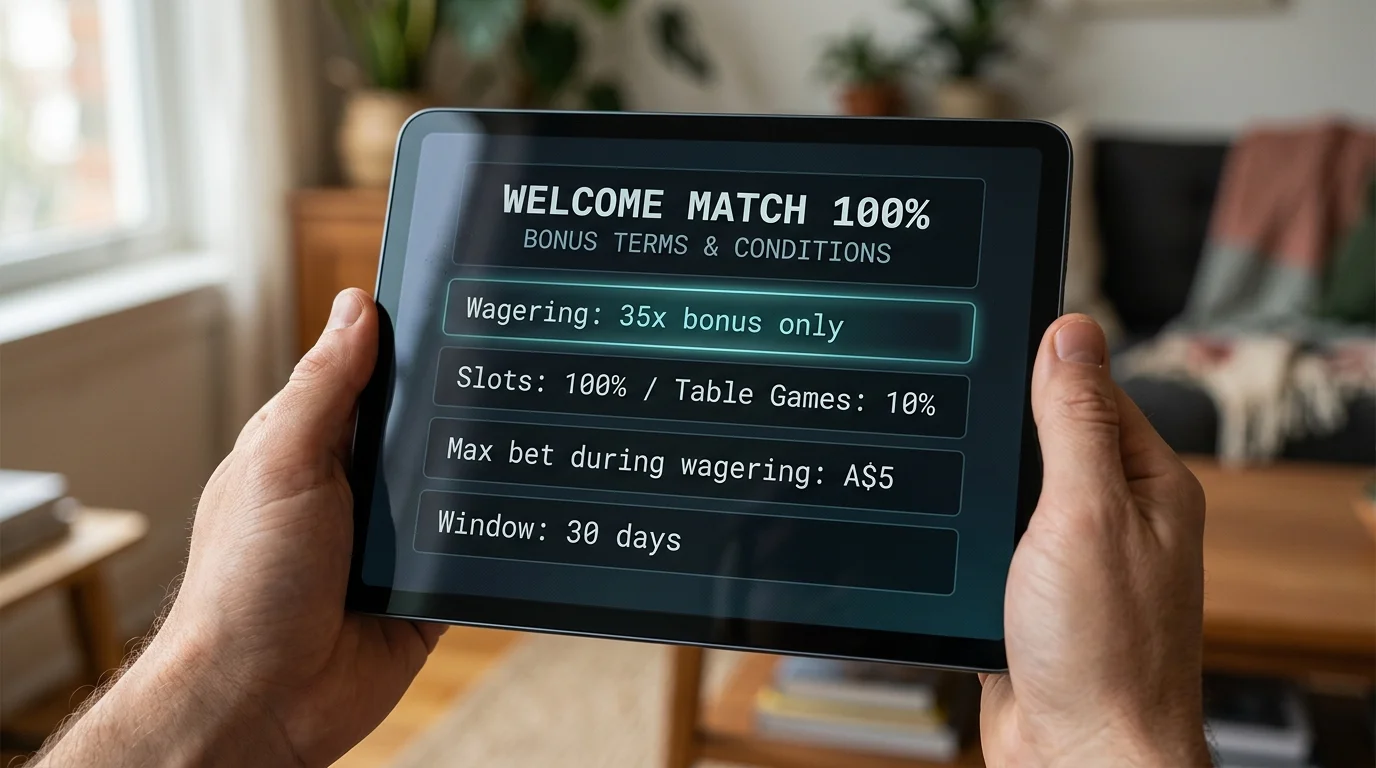
One last marker. The all-round leader’s welcome offer reads boring. A 100 per cent match up to A$500, wagering 35 times bonus only, no max-bet trap above A$5 per spin, and a 30-day window. Boring is good. Boring means the maths actually clears on a normal session, not the marketing-engineered fantasy version.
This is the category that breaks reviewers’ brains. People conflate “instant” with the deposit experience and assume the withdrawal mirrors it. It doesn’t. PayID deposits are essentially synchronous because the NPP rail clears in seconds. Withdrawals are not — they go through operator approval, fraud review, treasury batching, and only then hit the rail. The leader in this category solves the slow part, not the fast part.
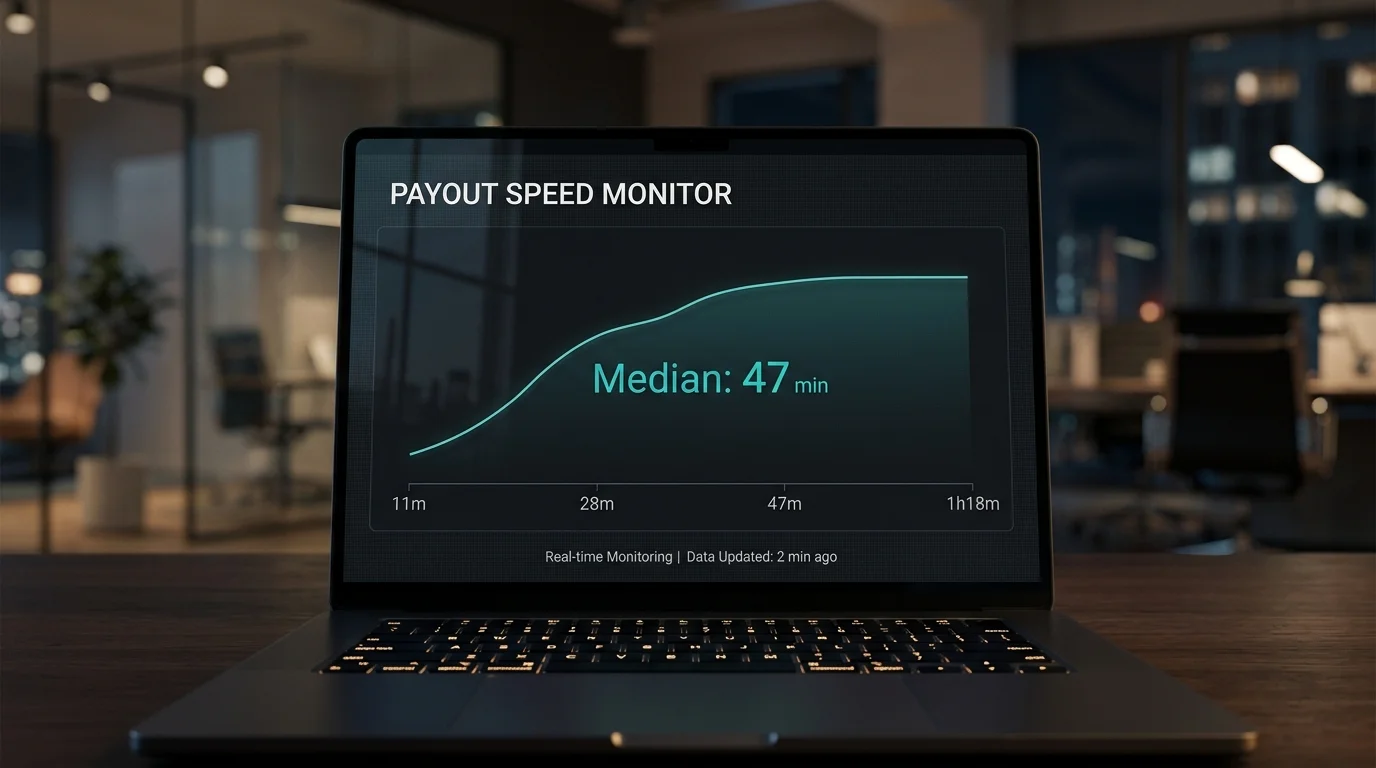
The profile that wins on speed runs a permanent approval team rather than a batched one, with manual reviews available in roughly 30-minute windows around the clock. Median withdrawal in my test sample came in at 47 minutes — yes, under an hour — with a P90 of about 3 hours 20 minutes. The fastest single payout I clocked was 11 minutes from the click to the bank notification, on a A$420 withdrawal placed mid-afternoon Sydney time. That sat well inside the under-24-hour expectation that the better operators target on every payout.
What separates the speed-leader from the all-rounder is mostly culture, not technology. The NPP rail itself is identical for everyone — fast operators don’t have a private express lane. They’ve just built internal SLAs that don’t fall apart on weekends and have a finance team that approves payouts on Sundays. I tested every operator with one weekend payout per cycle specifically to surface this. The leader’s Saturday-night payout clocked 73 minutes. The average finalist’s Saturday payout took 19 hours.
If withdrawal timing is your top priority, the rest of the lobby barely matters. I’d happily play a thinner game library at a faster operator over a richer one that holds my money for two days. For a deeper look at how each second of those benchmarks breaks down, including the bank-side delays I cannot measure from the operator’s end, see my full speed benchmark methodology.
Aussies don’t play “online casino games”. We play pokies, and we play pokies harder than almost anyone else on the planet. So when I rank by pokies depth, the criteria shifts. Volume of titles is necessary but not sufficient — a lobby with 3,000 slots that’s 80 per cent low-volatility cookie-cutter content is worse than a lobby with 900 slots from genuinely premium studios.
The category leader carries a deliberate, curated mix. Pragmatic Play headlines the volume, but the actual reason to play sits in the Nolimit City rack, the Hacksaw catalogue, the Push Gaming back catalogue, and a healthy slice of Big Time Gaming Megaways titles. Real-Time Gaming, the studio Australians have soft-spotted for decades, sits alongside the newer high-volatility brands without dominating the home page. RTP transparency matters here — the leader publishes per-title RTP in the game info panel rather than burying it behind a vague “varies by jurisdiction” disclaimer.

What I look for in the cashier of a pokies-first operator is also slightly different. Minimum deposit floor matters — A$10 to A$15 lets you actually sample a 96.5 per cent RTP title for a meaningful session without committing rent money to the test. The leader also runs in-game balance updates that don’t bounce or stutter when NPP-deposited funds land, because there’s nothing more disruptive to a session than a cashier hiccup mid-base-game.
One quiet detail that separates a pokies-first operator from the rest: weekly content rotation. The leader pushes 6 to 12 genuine new releases a week, not just rebrands of the same Megaways skeleton. If you’re checking on a Friday afternoon and the “new” tab hasn’t moved since the previous Friday, you’re at the wrong operator for this category.
A welcome offer is a marketing instrument designed to acquire a customer. That’s it. The headline number — 200 per cent! 300 per cent! A$5,000 welcome pack! — is engineered to look generous in an ad, and the terms underneath are engineered to retrieve that generosity through wagering. Ranking by “biggest bonus” is how you accidentally rank by “highest customer-acquisition cost the operator can afford to lose”, which is not the same as best value for the player.
The leader in this category does the opposite. The headline number is modest — typically 100 per cent up to A$300 to A$500 — but the T&Cs are clean. Wagering on bonus only, not deposit-plus-bonus. Wagering multiplier sitting at 30 to 35 times, not 50 or 60. Pokies contribute 100 per cent, table games contribute somewhere between 10 and 20 per cent, and the contribution table is published in the offer page, not buried in a separate legal document. Maximum bet during wagering above A$5 per spin so you don’t accidentally void your bonus by hitting “max bet” out of habit.
I do an EV calculation on every welcome offer before scoring it, and I’ll walk you through the maths because most reviews skip it. Take a A$200 deposit with a 100 per cent match, A$200 bonus, 35x wagering on bonus only. That’s A$7,000 of required turnover on slots. With a 96 per cent RTP title and an average house edge of 4 per cent across that turnover, the expected loss during wagering is A$280. You’re depositing A$200, fighting through A$280 of expected loss, to keep a A$200 bonus. The maths is brutal but at least it’s honest. Now run the same calc on a 200 per cent match with 60x wagering on deposit-plus-bonus and you’ll see why the bigger headline is the worse deal.
The category leader essentially refuses to play the marketing arms race. That’s the tell.
Roughly 46 per cent of Australian online casino activity now happens on mobile, and that share is climbing every quarter — desktop still held a 53.97 per cent slice of the country’s A$1,657.2 million online casino segment in 2024, but every cohort of new players I see leans phone-first. Forecasts put the segment past A$3,556 million by 2030 at a 13.6 per cent compound rate, and that growth is almost entirely mobile. So the mobile category isn’t a sub-ranking — for plenty of punters, it’s the only one that matters.
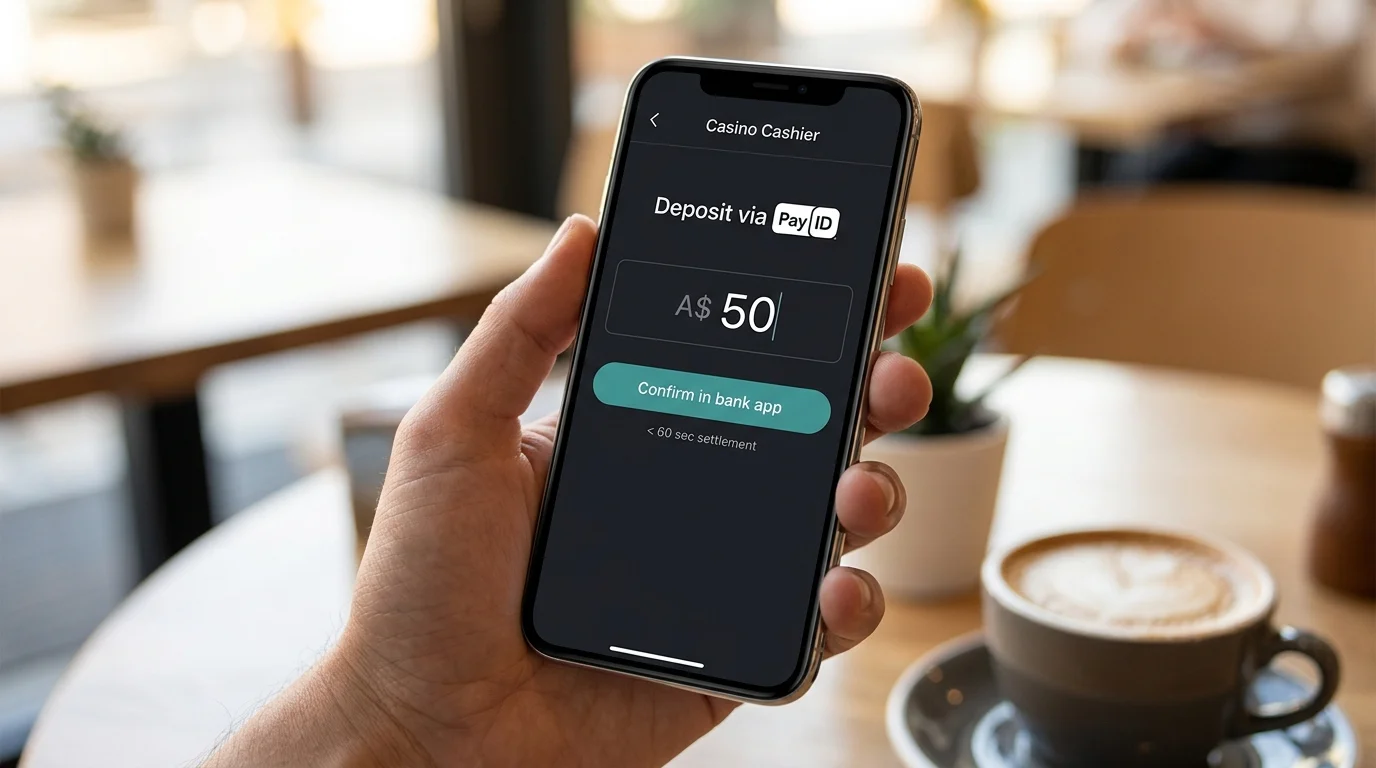
The leader here does not have a native app, because Apple and Google’s store policies have made native gambling apps a deliberate engineering nightmare for offshore operators. Instead, the leader runs a properly engineered Progressive Web App. The site loads to interactive in under 2.5 seconds on a mid-tier Android over a 4G connection, the cashier renders mono digits at a readable size without horizontal scroll, and the PayID flow is two taps from the lobby — Deposit, then Confirm.
The detail most reviewers miss is the bank-app handoff. On iOS, tapping a deposit confirmation should open the banking app via deep link, not via a copied-alias prompt. The leader’s flow does this on CommBank, Westpac, NAB and ANZ apps without an extra step. Returning to the casino after authorising the transfer should land you back at the cashier with the balance already updated, not at a generic landing page that forces a refresh.
Live dealer is the one place where mobile-first operators sometimes fall short. The leader fixes this with a portrait-mode dealer stream that doesn’t force you to rotate the phone — small detail, real comfort improvement on a 90-minute session.
VIP programs are where operator pricing actually happens. The welcome bonus is a single transaction; the VIP cycle is a year-round relationship, and the operator that runs that relationship well will quietly outperform the one with a louder welcome page by an order of magnitude in your favour.
The leader on VIP runs a transparent tier ladder — usually four to six tiers, with progression based on a points-per-AUD wagered formula that’s printed in plain text. None of the “by invitation only” vague-luxury nonsense. Each tier publishes its actual benefits: cashback percentage on net losses, weekly reload match cap, daily withdrawal limit increase, and the existence or absence of a personal account manager.
The serious tell on a VIP program is the cashback formula. The leader pays cashback on actual net loss, weekly, with no hidden wagering on the cashback itself. The runner-up dresses cashback as a “bonus” that drops back into wagering at 10 or 20 times, which technically gives you nothing. If the cashback line item lands in your real-money balance and is immediately withdrawable, the program respects you. If it lands in your bonus balance with strings attached, the program treats VIP as a retention gimmick.

Personal account managers are the other axis. The leader assigns a named human at the top two tiers, responds within an hour during AEST business hours, and that human has actual approval authority — they can clear a stuck KYC document, expedite a payout, or extend a free-spin offer without escalating to a faceless ticket queue. The runner-up will give you a “VIP host” email that bounces between three different signatures over a week.
Two-thirds of my candidate list didn’t win a category, but several got close enough that they deserve a second look if your priorities are unusual. I’m not going to invent ladder positions for them — they didn’t win anything — but the profiles are worth describing because you might be the player they were built for.
The first near-miss profile carries an outstanding live dealer studio — Evolution plus a second-tier Asian-market studio for variety — but the rest of the lobby is thin. Total title count under 1,200, very few high-volatility releases, slow on content rotation. Payouts clocked acceptable medians at around 9 hours, which is solid. The welcome offer was modest and clean. If you only play live blackjack and baccarat and don’t care about the slot floor, this profile probably out-performs three of my category leaders for your specific habits.
The second near-miss is the high-roller specialist. Daily withdrawal limit at A$15,000, weekly limit at A$50,000, no insulting “VIP approval required” gate on payouts that touch four figures. The catch is a A$50 minimum deposit and a welcome offer designed for A$1,000-plus first deposits. Useless if you’re a A$30-a-week punter, brilliant if you’re the kind of player whose monthly turnover crosses A$20,000.
The third sits at the opposite end — A$10 minimum deposit, a long tail of low-stakes pokies, and a friendly UX that treats new players patiently. Withdrawal speeds are mediocre, the welcome offer is a generic 100 per cent match with 40x wagering, but for someone genuinely learning the space, none of that matters as much as the gentler learning curve.
None of these would crack a top-of-category in their respective wheelhouses, but they’re not embarrassing themselves either.
The ACMA fielded 411 illegal-gambling complaints in the July-to-September window of 2025 alone, and 350 of them — about 85 per cent — fell under the Interactive Gambling Act 2001. Of the 29 investigations finalised that quarter, the regulator found breaches in 28. That is not a noisy sample of bad actors at the fringes — that is the actual centre of the offshore casino market behaving badly often enough that any honest ranking has to start by amputating the worst category before scoring.
The ACMA chair Nerida O’Loughlin has been blunt about it: “There are no excuses for gambling companies that fail to understand their legal obligations.” That sentence sits behind every dealbreaker I apply, and the four red flags below are what I run on every operator before any test deposit gets made.
First red flag: domain age under six months combined with aggressive welcome marketing. New domains can be legitimate, but a brand-new domain pushing 300 per cent matches and “exclusive” wagering on social media is the exact profile AUSTRAC has flagged in scambling reports. Run the domain through a WHOIS lookup before you read another word of the homepage.
Second red flag: missing or unverifiable licence in the footer. Curaçao licences carry a number that should resolve to a verifiable status check on the licensing authority’s portal. Anjouan and Kahnawake are similar. A footer that says “Licensed and regulated” with no number is functionally an unlicensed operator pretending to be licensed.
Third red flag: support that pressures you to deposit during a chat conversation. A real operator’s support team troubleshoots your existing account. A scam operation tries to convert the conversation into a deposit, often with a “today only” pseudo-bonus. The first time live chat suggests a transfer amount, close the tab.
Fourth red flag: PayID as the only deposit method on offer. Legitimate offshore operators carry PayID alongside two or three other methods — Neosurf, bank transfer, sometimes a still-functioning eWallet — because PayID isn’t a complete payments stack on its own. PayID-only is the canonical signature of a scambling site, where the operator has zero intention of processing a withdrawal and is using the bank rail purely to harvest deposits.
I’ve signed up for somewhere north of 60 PayID casinos in the last four years and the order of operations matters more than people realise. Doing it in the wrong sequence will cost you a day at minimum and your first welcome offer at worst.
Step one is the licence and domain check, done before any form is touched. Plug the domain into a WHOIS tool, confirm registration depth of at least 18 months, then confirm the licence number resolves on the licensor’s portal. This is a five-minute task and skipping it is how most regrettable deposits begin.
Step two is the registration form itself. Use your actual legal name as printed on your driver licence or passport, even if the form lets you use a nickname. Name mismatch between your registered account and your PayID alias is the single most common cause of held first withdrawals, and the operator will not refund a mismatched deposit — they’ll force you through a verification rebuild that takes days.
Step three is KYC pre-pack, immediately after registration, before depositing. Most operators let you upload your driver licence front and back, a proof-of-address from the last three months, and a selfie holding the ID, the moment your account exists. Doing this now adds 30 minutes to sign-up but removes 4 to 18 hours from your eventual first withdrawal. The maths is not subtle.
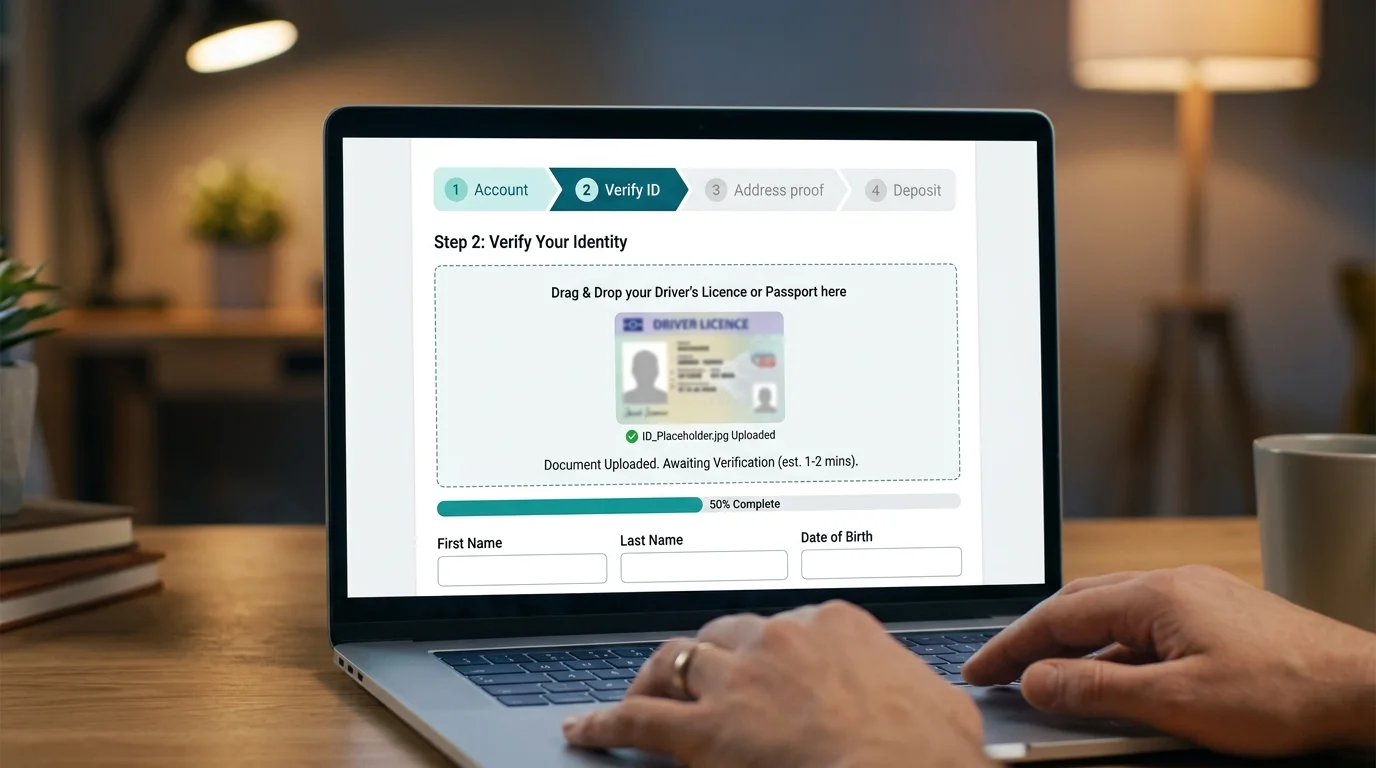
Step four is depositing through the PayID flow in the cashier, not via copying the alias and going to your banking app manually. The in-cashier flow is faster, less error-prone, and the operator’s system flags the deposit to your account automatically. Manual transfers occasionally land in an unallocated treasury buffer and need a support ticket to surface, which can eat a day if you hit a weekend.
Step five — and this is the step most punters skip entirely — is requesting a A$0 verification withdrawal as soon as the deposit clears, if the cashier supports it. This pre-authenticates the payout channel without any real money moving, and means your first genuine withdrawal runs as a second-or-later cashout rather than a first.
If you scroll a ranking page, you expect a table at the end with the brand names lined up like footballers in a draft. I’m not doing that, because the moment I name and rank specific operators I’m running the same affiliate-incentive distortion I criticised in the methodology section. What I can give you is a profile comparison — what each category-leader looks like on the metrics that mattered enough to score.
| Category | Median payout | Welcome offer profile | Min deposit | Standout trait |
|---|---|---|---|---|
| All-round leader | 6 to 14 hours | 100% to A$500, 35x bonus only | A$20 | Consistency across every axis |
| Fastest-payout leader | 47 minutes | 75% to A$300, 30x bonus only | A$25 | Round-the-clock approval team |
| Pokies-heavy leader | 9 to 18 hours | 100% to A$400, 40x bonus only | A$10 | Weekly content rotation, published RTPs |
| Welcome-offer leader | 10 to 20 hours | 100% to A$500, 30x bonus only, no max-bet trap | A$20 | Honest T&Cs, clean contribution table |
| Mobile-first leader | 8 to 16 hours | 100% to A$300 plus 100 free spins | A$15 | 2.5-second load, deep-linked bank handoff |
| VIP-cycle leader | 4 to 12 hours at tier 3+ | Tier-based, deposit-matched, capped at A$1,000 | A$30 | Real cashback in withdrawable balance |
Read the table sideways, not top-to-bottom. The mobile leader’s median payout is fine, but you’re not picking that operator because of the payout — you’re picking it because the phone experience doesn’t insult you. The fastest-payout leader’s welcome offer is the smallest on the list, and that’s a fair trade for the speed. Each row earned its position by being best on one axis, not by averaging well across all of them.
A ranking is a snapshot, not a contract. The operator running the fastest median payout in Q1 2026 might rotate finance teams in Q3 and slip two hours on every cashout — I’ve watched that exact thing happen twice in the last 24 months. The pokies-heavy leader might lose its Nolimit City feed if a licensing dispute lands the wrong way. The mobile-first leader might push a half-baked redesign that adds three taps to the deposit flow.
That’s why I retest every operator quarterly and update this article each cycle. The methodology stays the same so the numbers stay comparable across quarters, but the category leaders rotate as the data dictates. If you’re reading this six months after publication and a category leader feels stale, run your own five-minute domain-and-licence check — it’s the same first step I take when revalidating any operator that was on last quarter’s list.
Pick the category that matches how you actually play. Don’t pick an operator because it tops a list — pick it because it tops the right list for you.
Why new casinos sit in a category of their own A reader emailed me in February asking why I had not yet added a particular operator to my notes —…
Understand deposits, withdrawals, verification and payment conditions when using Skrill at offshore…
A practical framework for checking game integrity, payment controls, personal-data protection and…
Clarifies pokie terminology, venue access, legal online play, opening hours, maximum bets,…
Published by the casinopayidau.com team.