Westpac PayID for Casino Deposits
How Westpac's flow differs from the CommBank baseline The second-most-common bank I see in PayID casino deposits is Westpac, and the user experience differs from CommBank in ways that matter.…

How the PayID welcome match really plays out: 100% vs 200%, A$20 minimums, multi-tier packs and small print that decides your real value
 Available in AU
I track welcome-bonus terms across the AU-facing market the way analysts track earnings reports — quarterly, in a spreadsheet, with every percentage and clause logged. Here’s the data point that surprises new players: PayID deposits qualify for the full welcome match at virtually every operator I’ve audited in the last three years. There’s no “PayID exclusion clause” the way there used to be for some e-wallets. If anything, PayID is the preferred deposit channel from the operator’s side, because instant settlement removes the chargeback risk that historically clipped welcome offers tied to card deposits.
That alignment matters because it shifts the question from “will my bonus actually trigger?” to “is the bonus worth taking at all?” Across the next 1,500 words I’ll walk through the match formulas you’ll see, the deposit minimums that gate them, the multi-tier packages that span your first five funded sessions, and the conditional clauses that quietly reshape the value. The maths is the maths — but reading it before clicking “Activate Bonus” is the difference between an aligned offer and a trap.
The standard welcome match in the PayID-friendly segment runs at 100%, but I see meaningful variance — 80% on the conservative end, 300% on the most aggressive. The formula is straightforward: bonus credit equals deposit amount multiplied by the match percentage, capped at the maximum bonus value stated in the offer. A 100% match up to A$500 means an A$300 deposit gives you A$300 in bonus credit. An A$700 deposit gives you A$500 in bonus credit — anything above the cap is unmatched.

The temptation is to maximise the match. A 200% offer up to A$1,000 looks like better value than a 100% offer up to A$500. Sometimes it is. Often the higher match percentage carries higher wagering — 45× rollover on the 200% offer versus 30× on the 100% offer — and the playthrough required to convert the bonus to cash actually eats more variance than the lower offer would. I run a quick mental ratio: divide the wagering multiplier by the match percentage. A 35× wagering on a 100% match is 0.35 — quite acceptable. A 45× on a 200% match is 0.225 — better. A 60× on a 300% match is 0.20 — better still, on paper, but only if you have the bankroll to grind through the turnover.
Welcome match offers don’t activate at any deposit size. The standard activation threshold sits at A$20 or A$30 in 2026, with a small minority of operators dropping to A$10 and a few high-end platforms requiring A$50 to unlock the headline match. This minimum exists because the operator’s economics on an A$5 PayID deposit don’t justify the bonus liability — they want enough commitment from you to expect a real session.
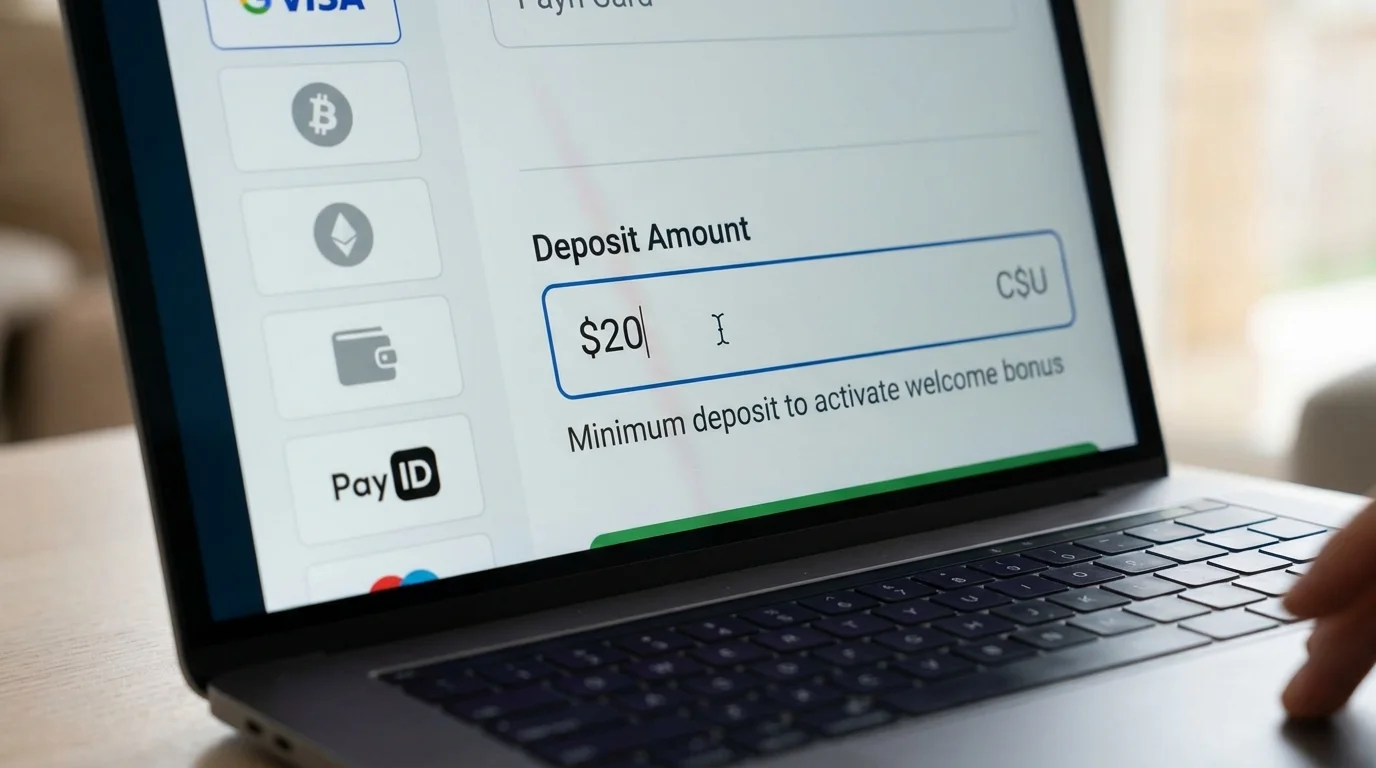
The market floor for funding sits at A$10 to A$30 across most operators, so the welcome-eligible deposit minimum is roughly aligned with what most players would put in anyway. The trap is at the bottom end: a player who funds A$15 expecting to “test the cashier” misses the bonus tier because the offer activates at A$20, then makes a second deposit specifically to claim the bonus, which most operators classify as the welcome offer being already missed. Welcome offers attach to the first qualifying deposit, not the second. Read the activation threshold before funding, not after.
Single-deposit welcome bonuses are increasingly rare. The mainstream structure in 2026 is the multi-tier package — usually three to five sequential funded sessions, each with its own match percentage. A typical structure: first deposit 150% up to A$500, second deposit 100% up to A$1,000, third deposit 75% up to A$1,500, fourth deposit 50% up to A$2,000. Stack those together and the headline reads “Up to A$5,000 in welcome bonuses across your first four deposits.”

That A$5,000 number is the marketing ceiling, not a realistic outcome. To capture the full ceiling, you’d need to deposit roughly A$8,000 of your own funds across the four tiers, accept the wagering attached to each tier (compounding turnover requirements), and complete each tier’s playthrough within its individual time window. Most players claim the first tier, sometimes the second, and let the remainder lapse — which is roughly the operator’s model.
The structural shift toward multi-tier packages tracks the broader growth in PayID adoption. NPP usage rose by 18 percentage points in 2025, and roughly half of Australian payment respondents reported at least one PayID transaction in the previous year — meaning operators can rely on the deposit channel being already familiar to new sign-ups, which makes multi-deposit acquisition campaigns viable in a way they weren’t pre-2023.
Let me put a real number through the machine. Suppose you fund an A$300 PayID deposit at an operator offering 150% match up to A$500, with 35× wagering on bonus only.

The match calculation: A$300 × 1.5 = A$450 bonus credit. Total playable balance: A$750. The wagering requirement: A$450 × 35 = A$15,750 in qualifying turnover before the bonus converts to withdrawable cash. Assuming you play standard pokies at 100% contribution and average an A$1 bet per spin, that’s 15,750 spins. At a comfortable pace of 600 spins per hour, that’s about 26 hours of focused play to clear the bonus. The 96% average RTP means your expected balance after those 15,750 spins is approximately A$15,750 × 0.04 = A$630 in net expected loss from your combined balance — which means the bonus, on average, doesn’t survive the wagering.
That sounds grim. The reason it works as a player proposition is variance — pokies don’t deliver the expected value smoothly. A high-volatility session over 15,750 spins delivers wild swings; some players bust early, some clear the bonus with a significant balance left. The maths describes the average outcome across thousands of players. Your individual outcome is the volatility around that mean. Knowing the average outcome is what separates an informed claim from a hopeful one. For the complementary side of welcome packages, the free spins as a welcome add-on piece walks through how spin allocations stack with cash match.
Six clauses appear in nearly every welcome bonus T&C and reshape the actual value. First, country exclusion lists — some operators exclude bonus eligibility for specific Australian states, usually based on the operator’s licensing geography. Read clause two or three of the terms. Second, eligible-games restrictions: some bonuses are pokie-only, some allow table games at reduced contribution, some prohibit live dealer entirely. Third, max conversion — a clause stating that the maximum convertible win from the bonus is capped at, say, 5× or 10× the bonus value, regardless of what you actually won.
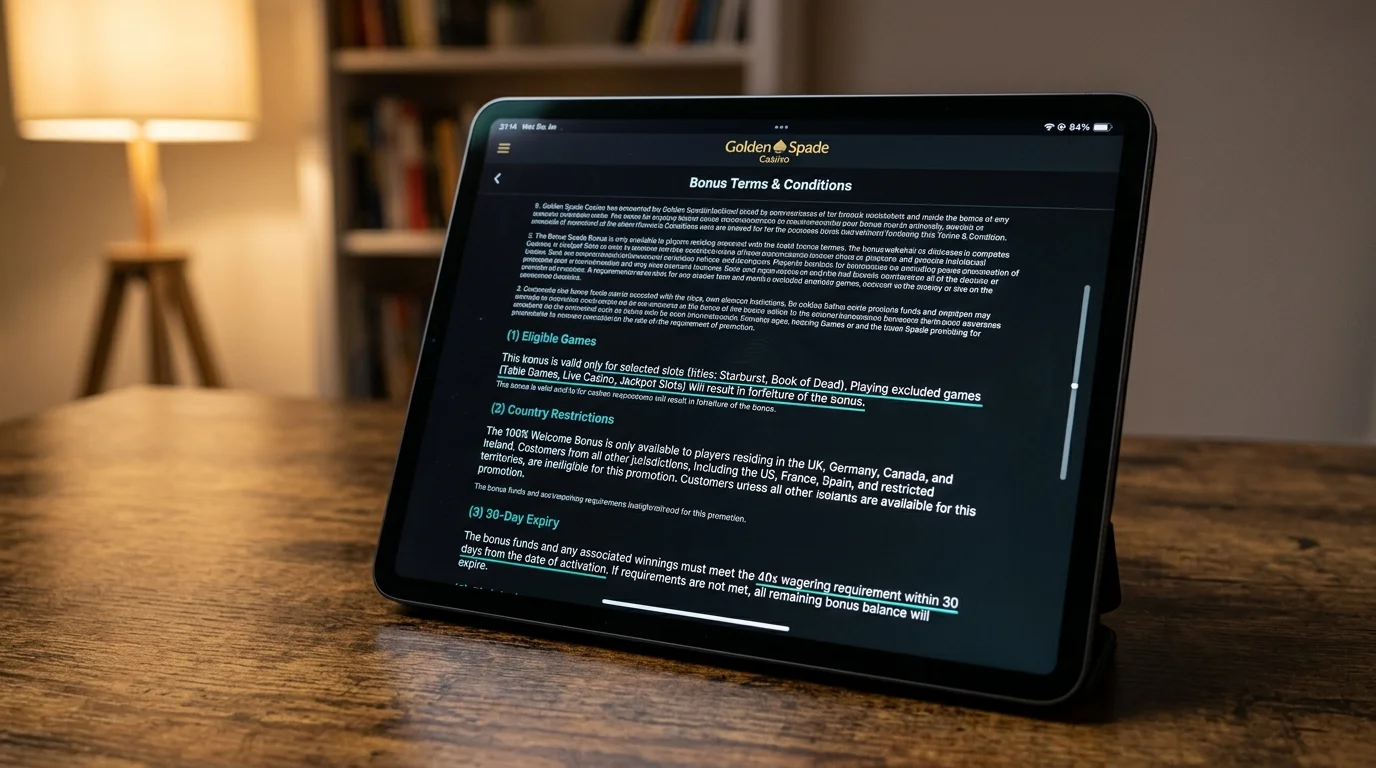
Fourth, expiry windows — bonus credit typically expires in 14 to 30 days from activation, with unfinished wagering forfeited. Fifth, max-bet rules during wagering — usually A$3 to A$5; exceed this once and the entire bonus voids retroactively, including winnings. Sixth, eligible-deposit-method clauses, which historically excluded some payment rails from welcome bonuses; PayID is consistently included in 2026, but always worth verifying in the specific operator’s T&C.
The framing matters here. As one ANU research team put it in the 2025 Gambling Participation report, “findings highlight intensifying harm despite declining participation, highlighting a critical need for regulatory and public health responses targeting online gambling.” Welcome-bonus mechanics are part of that landscape. Knowing the conditional structure isn’t just maths optimisation — it’s how you keep a clear-eyed view of what you’re actually agreeing to when you click “Activate.”
After running thousands of these calculations, three criteria filter the offers worth claiming from the offers that mathematically punish you. First criterion: match percentage at or above 100% with wagering at or below 35×. The 0.35 ratio is the sweet spot — high enough rollover that the operator can sustainably offer it, low enough that the playthrough is realistic. Second criterion: maximum cashout at or above 10× the bonus value. An A$500 bonus with an A$2,000 max cashout gives you room for variance to actually pay off; an A$500 bonus with an A$1,000 cap rarely will. Third criterion: at least 14-day expiry, ideally 30 days. Anything tighter is a structural pressure to overplay.

Match an offer against those three filters before activation. If two of the three pass, the offer is fine. If all three pass, it’s a genuinely attractive structure. If only one passes, walk past — the welcome cycle resets at your next operator, and you have no shortage of options across the PayID-friendly segment.
How Westpac's flow differs from the CommBank baseline The second-most-common bank I see in PayID casino deposits is Westpac, and the user experience differs from CommBank in ways that matter.…
The verification you can skip until your first cashout The single biggest…
The 3 AM test that reveals the operator no marketing copy describes…
The transition that closed an era and opened the current one POLi…
Created by the "casinopayidau.com" editorial team.