PayID Casino Wagering Requirements
Why wagering is the number that decides whether a bonus is real A reader sent me a screenshot last month with a triumphant message: 300% match on first deposit, up…

VIP tiers at PayID casinos for Aussies: how cashback scales, what each level unlocks, and when the rewards beat plain bonus hunting
 Available in AU
A reader who turns over about A$8,000 a month asked me last quarter whether his operator’s “Gold tier” was actually worth what it looked like on the lobby page. The headline was 8 per cent weekly cashback and a personal manager. The reality, once I checked the T&Cs and ran his numbers, was 8 per cent cashback subject to 5x wagering on a 30-game whitelist, a manager he had never interacted with, and a tier-decay clock that would drop him back to Silver after fourteen days of inactivity. Expected value worked out to roughly A$60 a month — about half of the headline and substantially less than the bonus he was passing up because he was VIP-qualified.
VIP programmes at PayID casinos are real, and at sufficient turnover they are genuinely valuable. They are also among the most misunderstood mechanics in the entire offshore market. The difference between a working VIP relationship and a marketing fiction sits in the structure: tier progression, what each tier actually gives, the wagering attached, and the operator’s discretionary control. This piece walks the structure end to end.
The standard structure across the AU-facing offshore market is four to seven tiers. The most common shape is six: Bronze, Silver, Gold, Platinum, Diamond, and Black (or Elite, Royal, Onyx — naming is theatrical, structure is identical). A small number of operators run streamlined three-tier programmes, and a handful at the high end go to seven or eight tiers with separate invite-only segments above Diamond.

Movement between tiers runs on a points or turnover ledger that resets on a defined cycle. The most common cycles are calendar month and rolling 30-day window. Calendar-month resets are cleaner for the player — you know exactly when the clock restarts — but rolling-30-day cycles let you maintain status by topping up turnover continuously rather than hitting a hard target by month-end.
Each tier sits behind a turnover threshold. Bronze entry is usually free with first deposit. Silver kicks in at A$500 to A$1,000 turnover per cycle. Gold at A$2,500 to A$5,000. Platinum at A$10,000 to A$20,000. Diamond at A$50,000 plus. Black is almost always invite-only and the threshold is internal.
The dropdown mechanic catches many players. Tiers usually persist for two to four weeks after the qualifying period if turnover drops, then the player gets bumped one or two levels down. The drop is often quiet — no email, no in-app notification — and the player only notices when the cashback percentage at the next payout cycle has halved.
The standard reward structure is a four-line item: cashback percentage, bonus conversion rate, personal manager, withdrawal cap uplift. Different operators emphasise different lines, but the four-line structure holds across virtually every programme worth describing.
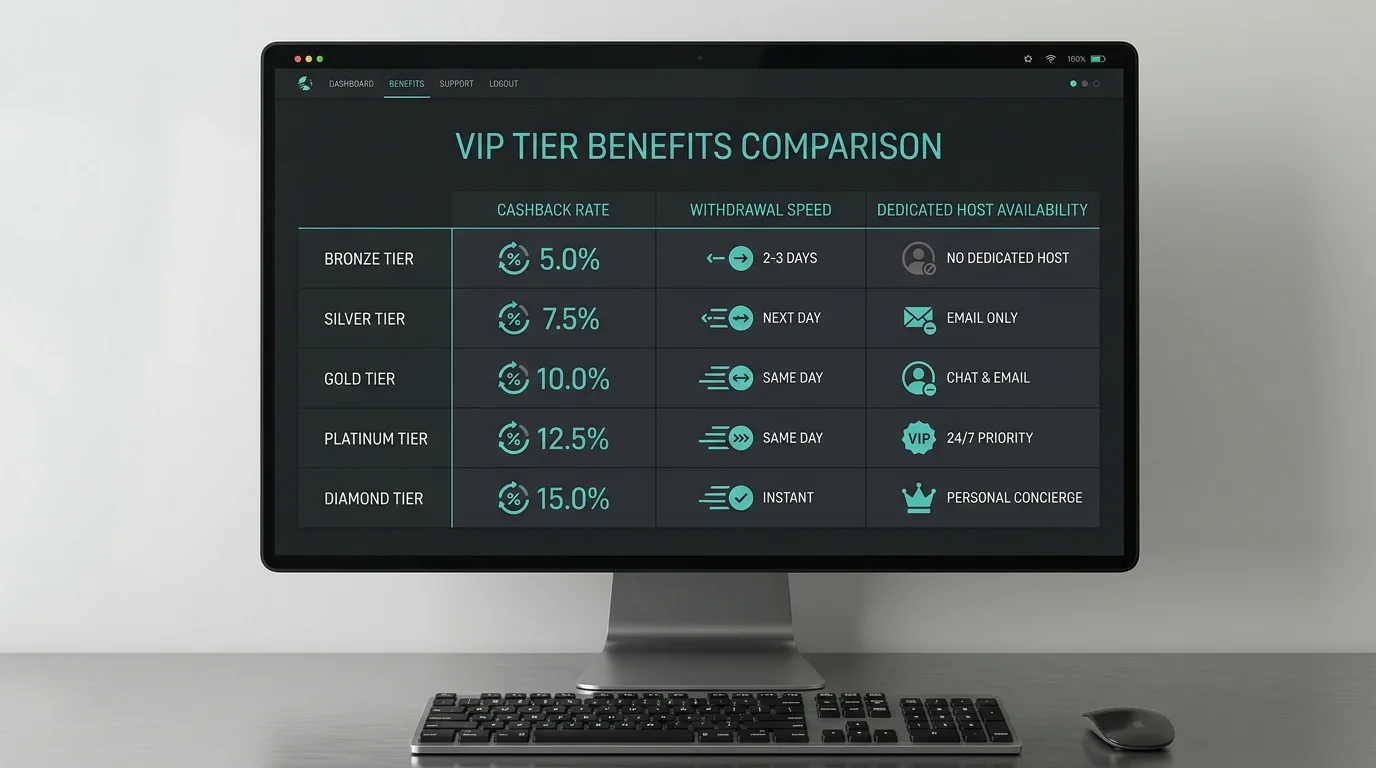
Cashback starts at 2 to 3 per cent weekly at Silver and climbs by roughly 1 to 2 percentage points per tier. Gold sits at 5 to 6 per cent, Platinum at 8 to 10 per cent, Diamond at 12 to 15 per cent, Black at 18 to 25 per cent. Cashback is paid on net losses for the cycle, not turnover, which is the single most important detail. A player who wins for the week gets no cashback regardless of tier.
Bonus conversion improves with tier. A standard welcome offer might run 200% match with 40x wagering. The same operator’s Platinum tier gets weekly 100% reloads at 25x with a 48-hour clear window. Smaller in headline percentage but materially more profitable on expected play time.
Personal managers appear from Gold or Platinum at most operators. The manager handles bonus negotiation, faster withdrawal escalation, custom limit increases, and birthday gifts. The genuine value is the escalation channel — a single contact who can push a stuck withdrawal through compliance in two hours instead of two days. Withdrawal caps lift with tier: A$5,000 daily at Silver, A$10,000 at Gold, A$25,000 at Platinum, uncapped at Diamond and above. For what happens above Diamond, see high-roller perks beyond standard VIP.
Most operators run tier progression on turnover, not net deposit. This matters because the Australian gambling market posts A$244.3 billion of total turnover per financial year against far smaller net deposit volumes — turnover is the metric the industry tracks because it captures the actual volume of play, not the financial outcome.

For VIP purposes, turnover is summed across qualifying games. Slots usually count at 100 per cent. Table games and live dealer often count at 10 to 50 per cent of wager. Sportsbook bets in side products at 50 per cent. The exact contribution rates are buried in the loyalty terms and they are not the same as the bonus contribution rates — players assume one set of rules applies to both and burn time playing the wrong game type for the wrong objective.
The roll-over windows matter as much as contribution rates. A Platinum tier requiring A$20,000 turnover in a calendar month means you generate that turnover by the 30th. Missing by 5 per cent on the 31st drops you to Gold for the next cycle. Some operators offer “tier protection” — a one-month grace period after qualification — and that feature alone is worth several percentage points of effective return for any player with variable monthly volume.
Almost every VIP programme runs a parallel comp points system. Comp points accumulate on every qualifying bet at a defined rate — typically 1 point per A$10 wagered on slots, 1 point per A$50 wagered on table games. The accumulated points convert to cash or bonus credit at an operator-set rate, most commonly 100 points = A$1.

The interaction with tiers is that higher tiers accumulate points faster. Bronze might earn at the base rate. Silver at 1.25x. Gold at 1.5x. Diamond at 2x. The compound effect is meaningful — a Diamond player at 2x earn rate plus 12 per cent cashback is pulling roughly 15 per cent total return-to-stake on losses, before any bonus activity.
The catch is the conversion floor. Most operators require a minimum point balance — typically 1,000 or 2,500 points — before conversion is allowed. Below the floor, points accumulate but cannot be spent, which locks small balances in the comp ledger. The other catch is expiration: points typically expire after 90 to 180 days of inactivity, so the comp balance of a player who stops for three months can reset to zero without notification.
The Australian online gambling market sits at US$5.5 billion in 2025 and is projected to reach US$9.0 billion by 2034 at 5.67% CAGR — a market large enough that operators compete genuinely on VIP economics rather than treating them as marketing decoration. Not every operator does this, but the ones that do are recognisable by structure.

The profile of an operator running a functional VIP-plus-PayID combination: published tier thresholds in plain numbers, not “based on activity”; cashback paid weekly without wagering attached, or with wagering disclosed clearly at 1x to 3x not buried at 35x; comp points convertible at 100:1 or better; personal manager assignment within 7 days of qualifying for Gold or above; and most importantly, a stated tier-protection window that is documented in the loyalty terms rather than promised verbally.
The other distinguishing trait is withdrawal handling at higher tiers. Functional VIP programmes either remove withdrawal caps above Platinum or document the exact AML throttle — for example, “withdrawals over A$25,000 are split into A$10,000 daily tranches over three business days, processed in priority queue.” That specificity in writing indicates an operator that has actually thought through the high-value withdrawal flow. Operators that just say “VIP withdrawals are fast” without numbers are signalling that nothing specific has been built.
The four traps to read for. First, cashback wagering. Some operators pay cashback as bonus credit subject to 5x to 15x wagering before withdrawal is permitted. That converts an apparent 10 per cent cashback into effective 1 to 2 per cent expected value, because most of the wagering will be lost back to the house edge. Cashback paid as cash or at 1x wagering is the only structure worth treating as real money.
Second, status expiration. Tiers can decay on inactivity windows as short as 7 days at some operators. A player who takes a fortnight off can return to find their Diamond status reduced to Gold, with the climb-back path running another full cycle. Operators with 60-day or 90-day decay clocks are dramatically more friendly to real-world play patterns.
Third, the unilateral discretion clause. Most operators reserve the right to remove VIP privileges “at any time, for any reason, without notice.” This sounds standard but is the legal lever pulled when a profitable player gets too profitable. Enforceable in offshore jurisdictions, and the only protection is keeping actual cash withdrawn rather than parked in the operator’s wallet.
Fourth, the game restriction clause. Higher tiers often have eligible-game lists that exclude high-RTP slots and most table games — the “extra” benefits attach only to highest-edge games. Reading the eligible-games list before chasing tier progression is the difference between a programme that pays and one that just looks like it does.
The break-even point for VIP being worth chasing sits around A$10,000 of monthly turnover. Below that, the cashback and comp earn rates do not outweigh the welcome and reload bonuses available to non-VIP players. Above A$10,000 per month, VIP starts to be the dominant return source, and above A$50,000 per month, Diamond and Black tiers pay meaningfully more than any bonus campaign could match. The bracket between A$10,000 and A$50,000 is where the VIP-versus-bonus calculation is closest, and where reading the specific tier terms matters most.
Why wagering is the number that decides whether a bonus is real A reader sent me a screenshot last month with a triumphant message: 300% match on first deposit, up…
The threshold that changes how the cashier behaves The first time I…
Where the actual ceiling on your payouts sits A player who has…
Why no-deposit bonuses are the unicorns of the PayID segment Three weeks…
Created by the "casinopayidau.com" editorial team.