Scambling
The hybrid term AUSTRAC coined to describe what was already happening The word "scambling" first appeared in AUSTRAC intelligence material in December 2025 to describe a financial-crime pattern that had…

35× vs 60× wagering on an A$500 PayID bonus: real maths, game contribution rates, max-bet rules and the small print that voids your winnings
 Available in AU
A reader sent me a screenshot last month with a triumphant message: 300% match on first deposit, up to A$1,500. The headline read like a giveaway — but the wagering line at the bottom read “60x on deposit and bonus.” When I ran the numbers back to him, his A$500 deposit would generate A$1,500 in bonus, total bonus pool A$2,000, wagering requirement A$120,000 of qualifying turnover before any of it could be withdrawn. Slot-only contribution at 100 per cent. House edge averaging 4 per cent on the typical operator catalogue. Expected loss across A$120,000 of turnover: A$4,800. The bonus, in expected-value terms, was worth negative A$3,300. He had been about to take it.
Wagering is the single most important number in any bonus offer because it controls whether the bonus pays out at all. The match percentage and the headline dollar figure are marketing. The wagering multiplier is the financial substance. This piece walks the three formula types, the typical multiplier ranges, the contribution mechanics by game category, the max-bet rules that void bonuses, the hidden clauses, and a worked calculation. Read all of it before claiming any bonus over A$200, because the math is not difficult but the wrong choice costs real money.
Wagering requirements come in three structural shapes. The shape determines how much turnover you actually owe relative to the bonus amount, and the differences are substantial.

Deposit-plus-bonus wagering (D+B): the multiplier applies to the sum of deposit and bonus. An A$300 deposit plus A$300 bonus equals A$600. At 35x D+B, the wagering requirement is A$21,000 of turnover. This is the most common structure and the strictest one. Most AU-facing offshore operators run D+B as their default.
Bonus-only wagering (B): the multiplier applies to the bonus alone, not the deposit. An A$300 deposit plus A$300 bonus at 35x B equals A$10,500 of turnover. The deposit can be withdrawn separately at any time. This is friendlier for the player by roughly half, and the operators that offer B-only structures are signalling a more generous bonus policy generally.
Deposit-only wagering (D): the multiplier applies to the deposit alone. An A$300 deposit at 1x D for a “deposit unlocks” bonus equals A$300 of turnover before the bonus is released. This is rare in standard welcome offers but appears occasionally in cashback structures, where the cashback amount unlocks after the original deposit has been wagered through once.
The structural test is to read the bonus T&Cs and find the wagering paragraph. Look for “deposit and bonus,” “bonus amount,” or “deposit only” as the qualifying base. Operators that bury this detail or use ambiguous phrasing should be treated with caution — the ambiguity itself is a sign that the operator wants the player to assume the friendlier structure when in fact the stricter one applies.
Wagering multipliers across the AU-facing offshore market run in four bands, each carrying different practical implications for whether the bonus is profitable in expected-value terms.
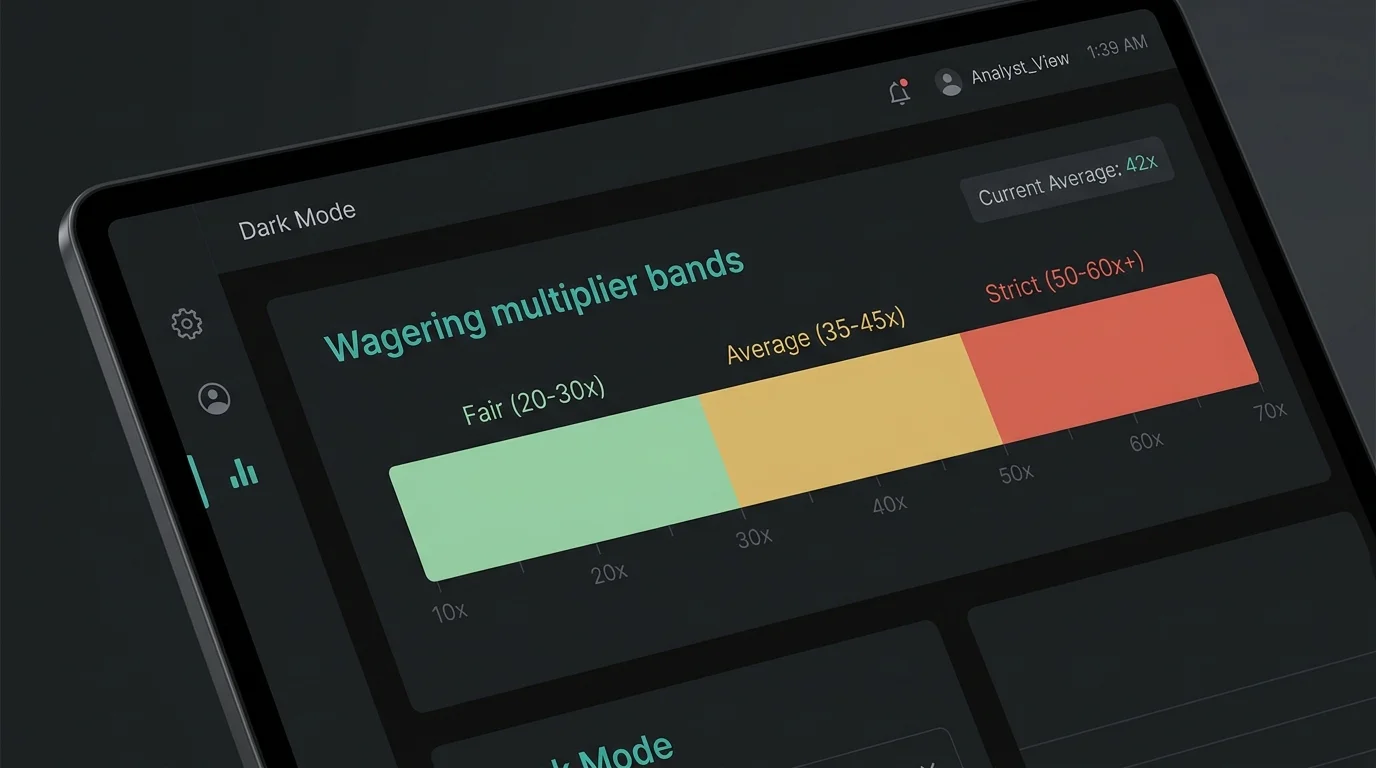
Below 25x is the soft band. Operators offering 20x or lower on welcome bonuses are running offers that are genuinely close to neutral expected value, sometimes positive for grinders who can manage the playthrough at low-edge titles. These offers are rare on the standard welcome match but appear more often on reload bonuses for VIP-tier players. If you see 20x or lower, treat it as a serious offer worth claiming.
25x to 35x is the standard band where most welcome bonuses sit. At 25x, the offer is mildly negative expected value for the typical player but can be marginal-positive for high-volume slot players at low-edge titles. At 35x, the offer is firmly negative expected value and only makes sense if the player was going to deposit anyway and the bonus extends play time as a side benefit.
40x to 50x is the strict band. Operators in this range are not offering genuine value — the bonus exists to inflate the headline percentage and most players are unlikely to clear the wagering. At 45x on D+B, an A$500 deposit plus A$500 bonus requires A$45,000 of turnover.
60x or higher is the predatory band. Operators offering 60x wagering on standard welcome bonuses are essentially announcing that they do not expect anyone to clear it. Avoid.
The wagering requirement is the gross turnover number — but not every game contributes equally toward it. Game contribution rates determine how much of each bet counts. The rates vary by operator but follow a recognisable pattern.
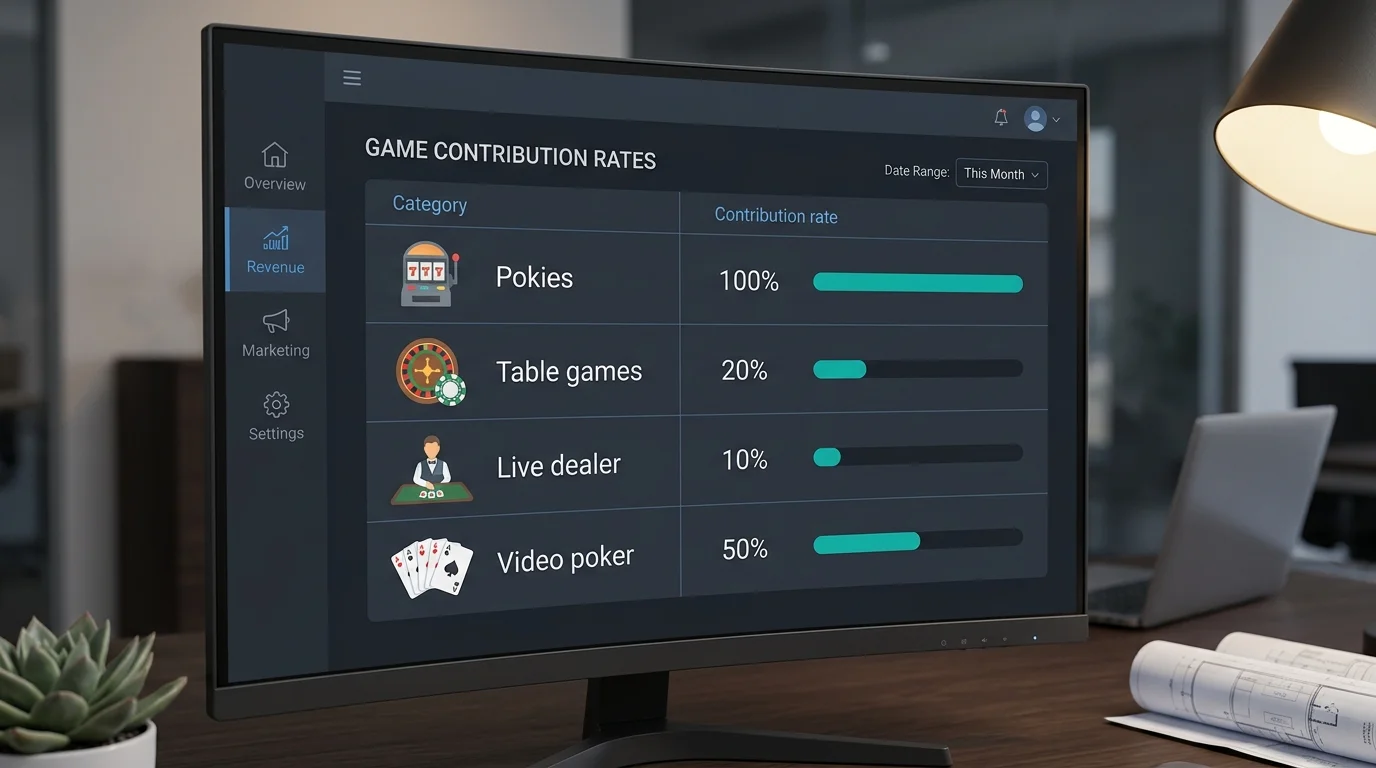
Slots: 100 per cent at almost every operator. Slot wagering is the operator’s preferred channel because the house edge is high (typically 3 to 5 per cent) and bonus playthrough generates predictable revenue.
Video poker: 10 to 20 per cent. The low contribution is because video poker can be played at house edges below 1 per cent with optimal strategy, which would make bonus farming trivially profitable. The contribution penalty normalises expected return.
Table games (blackjack, roulette, baccarat): 5 to 20 per cent. Same logic as video poker. Blackjack with basic strategy carries a house edge under 1 per cent; the 5 to 10 per cent contribution rate brings the effective bonus cost back in line with slot economics.
Live dealer: 10 to 20 per cent at most operators, with some explicitly excluding live tables from bonus play entirely. The live dealer category often has the most aggressive contribution penalties because the games carry the lowest house edges in the entire catalogue. For the specifics on how different live providers handle bonus contribution, see live dealer game selection and contribution rates.
Specialty games (scratch cards, keno, bingo): 50 to 100 per cent depending on operator. These games carry high house edges and are usually fine for bonus play, though the entertainment value is limited.
The practical takeaway: stick to slots during bonus play unless the bonus terms explicitly allow other categories at full contribution. Playing table games during wagering at a 10 per cent contribution rate means each A$10 bet counts as A$1 toward the requirement — meaning you have to wager ten times as much to clear the bonus.
This is the clause that catches the most players because it is buried in the T&Cs and the cashier does not warn you when you exceed it. Almost every bonus carries a max-bet rule during the wagering phase — typically A$3 to A$5 per spin or per hand. Bet above the maximum even once during wagering and the operator’s compliance team can void all bonus funds and any winnings derived from them.
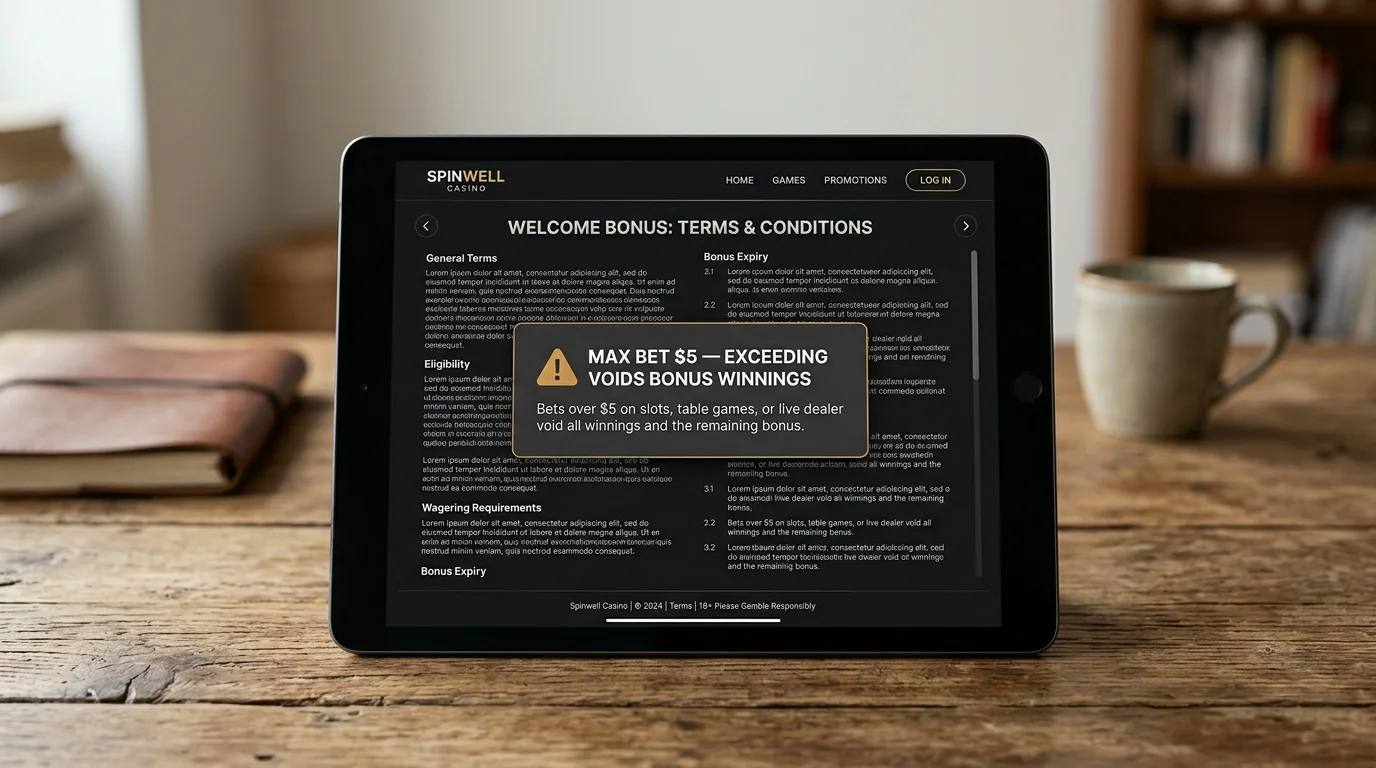
The enforcement is automated. The operator’s bonus engine tracks every bet against the registered bonus, and any wager above the max-bet threshold gets flagged. The flag may not appear in your account immediately — many operators run the review at withdrawal time, which means a player can spend weeks wagering a bonus through and then have the entire balance voided when they try to cash out because of a single A$10 bet placed early in the wagering cycle.
The fix is simple: set your bet to the maximum allowed by the bonus T&Cs and do not deviate. If the max-bet is A$3, every spin during wagering is A$3 or less. Most players who get caught by max-bet rules did so accidentally — they switched games, the new game’s default bet was higher, they did not adjust before spinning, the engine flagged it, and the bonus was voided weeks later.
Let me walk a full example because the abstract numbers do not stick the way an end-to-end calculation does. PayID deposit minimums sit at A$10 to A$30 and per-transaction maximums at A$5,000 to A$20,000, which sets the natural range for welcome-bonus deposits. Take a typical mid-range offer: A$300 deposit, 100% match up to A$500, wagering 35x on deposit-plus-bonus, max bet A$5, slots-only.

Deposit: A$300. Bonus: A$300 (limited to the match, less than the A$500 cap). Bonus pool: A$600. Wagering requirement: A$600 × 35 = A$21,000 of qualifying turnover.
Slots-only at 100 per cent contribution means every A$5 spin counts as A$5 toward the requirement. To generate A$21,000 of turnover at A$5 per spin requires 4,200 spins. At a typical pace of 600 spins per hour, that is 7 hours of focused slot play.
Expected loss across A$21,000 of turnover at 4 per cent house edge: A$840. The bonus is A$300. Net expected value of taking the bonus: −A$540 — the playthrough is expected to lose more than the bonus is worth.
This is the calculation that determines whether to claim. For a player who was going to deposit A$300 and play slots anyway, the bonus extends play time without changing the expected outcome much because the loss was happening regardless. For a player who would not otherwise play A$21,000 of turnover, the bonus is a structural negative because it commits them to volume they did not want.
Bonus expiration windows: most welcome bonuses must be cleared within 7 to 30 days from credit. Slow players run out the clock before reaching the wagering target. The clock starts at credit, not at first wager, so a player who claims and then waits a week before playing has only 14 days remaining on a 21-day window.

Max conversion caps: some bonuses cap the amount of bonus-derived winnings that can be converted to cash, typically at 5x or 10x the bonus value. An A$300 bonus with a 10x conversion cap caps the maximum cashable winnings at A$3,000 regardless of how much you actually win during the wagering cycle.
Country exclusion: some bonuses are explicitly excluded for AU players even though the operator accepts AU registrations generally. Check the T&Cs for jurisdictional exclusions before claiming.
Game exclusions: even within “slots-only” categories, some specific titles are excluded — usually the highest-RTP titles like Book of 99, Mega Joker, or 1429 Uncharted Seas. Operators publish exclusion lists in the bonus terms but rarely surface them in the cashier.
The broader context worth noting: ANU POLIS research showed 19.4 per cent of Australian gamblers classified as engaging in risky gambling in 2025, up from 13.7 per cent in 2024. The escalation correlates with the proliferation of aggressive bonus offers that commit players to higher turnover than they would otherwise generate.
The rough rule of thumb is wagering at or below 35x with max-bet at or above A$5 and slots at 100 per cent contribution. Below 25x is genuinely good. Above 40x with low max-bet is genuinely bad. Inside the middle band, the decision depends on whether the player would otherwise generate the equivalent turnover at the same operator. The bonus is not a gift — it is a contract to wager a specific volume at a specific edge, and the only sensible question is whether that contract is one you would have signed without the bonus attached.
The hybrid term AUSTRAC coined to describe what was already happening The word "scambling" first appeared in AUSTRAC intelligence material in December 2025 to describe a financial-crime pattern that had…
The legal answer that ends the comparison before it starts The crypto-versus-PayID…
The verification you can skip until your first cashout The single biggest…
Why CommBank ends up being the default Aussie casino rail Roughly seven…
Written by the editors at casinopayidau.com.