PayID Account Name Mismatch at Casinos
The name match is a feature, not a bug The first time PayID rejected a deposit because of a name mismatch, I thought it was an error. Three years and…

NAB PayID for AU casino deposits: A$25,000 daily cap, Gambling Block coverage, Fraud Centre holds and how Aussies clear them fast
 Available in AU
NAB joined PayID in 2018 alongside the rest of the Big Four, but the bank’s casino-deposit experience is shaped by something the other three do not have to the same degree: NAB’s deep involvement in the Fintel Alliance, the public-private intelligence partnership between AUSTRAC, the Big Four, and selected non-bank financial institutions. That partnership feeds NAB’s fraud detection layer real-time signals from across the Australian financial system, with the result that NAB’s first-payment hold on offshore PayID transfers is consistently the longest and most rigorous of any Big Four bank.
For a casino-bound NAB customer, the practical effect is that the first PayID transfer to a given casino takes 2 to 24 hours to clear instead of the under-60-second standard. Every subsequent transfer to the same payee runs at full speed. The first-transaction pause is the cost of using a bank that puts more fraud-detection compute behind its outbound transfers than most retail customers will ever notice in any other context.
Open the NAB app, log in, and tap the Pay tab from the bottom navigation. Select “Manage PayID” from the payment options. The screen presents the standard alias choices: mobile, email, and ABN for business customers. Standard retail users will use mobile or email.
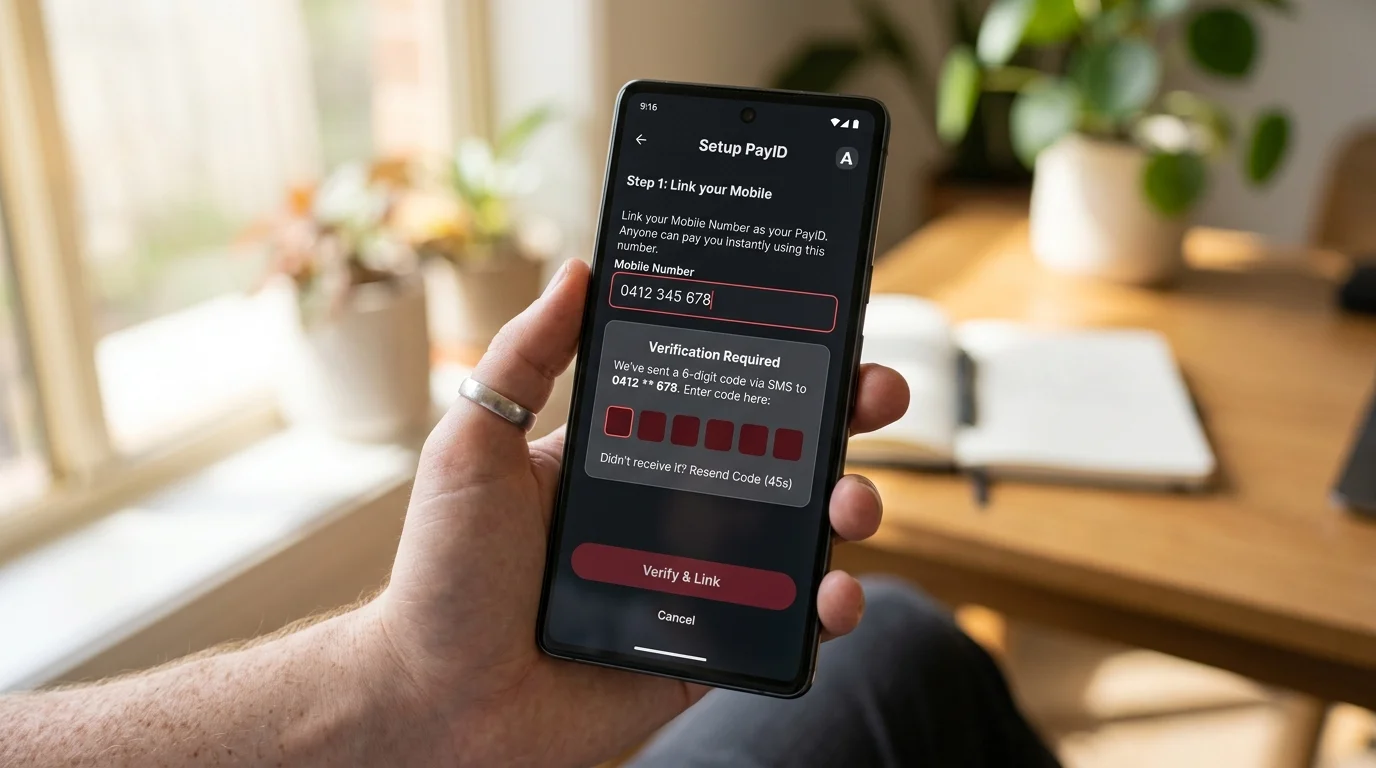
Tap “Create PayID,” choose mobile or email, and confirm the alias NAB has on file. The bank sends a confirmation code or link to the alias, and you confirm to activate. NAB’s flow differs slightly from CommBank’s in that it asks you to nominate the receiving account explicitly during creation rather than defaulting to your transaction account. If you have multiple NAB accounts, select carefully because changing the destination later requires going through the manage flow again.
NAB also surfaces an explicit consent screen during alias creation that walks through how PayID is used and what data is shared with other banks during transfers. This is a regulatory requirement that NAB chose to make more visible than its competitors. Tap accept and the PayID activates within seconds.
The NAB Internet Banking web portal supports the same setup flow for customers who prefer desktop. The functionality is identical, with the same alias options and verification steps; the only difference is the screen layout. Most NAB customers handle PayID setup through the app because the SMS verification flow is faster than the email verification used on desktop.
NAB’s default daily limit for new transaction accounts sits at A$5,000 per day, in line with Westpac and higher than CommBank’s default. The Big Four ceiling of A$25,000 per day in-app applies to NAB the same way it does to CommBank and Westpac, with ANZ being the outlier at A$20,000.
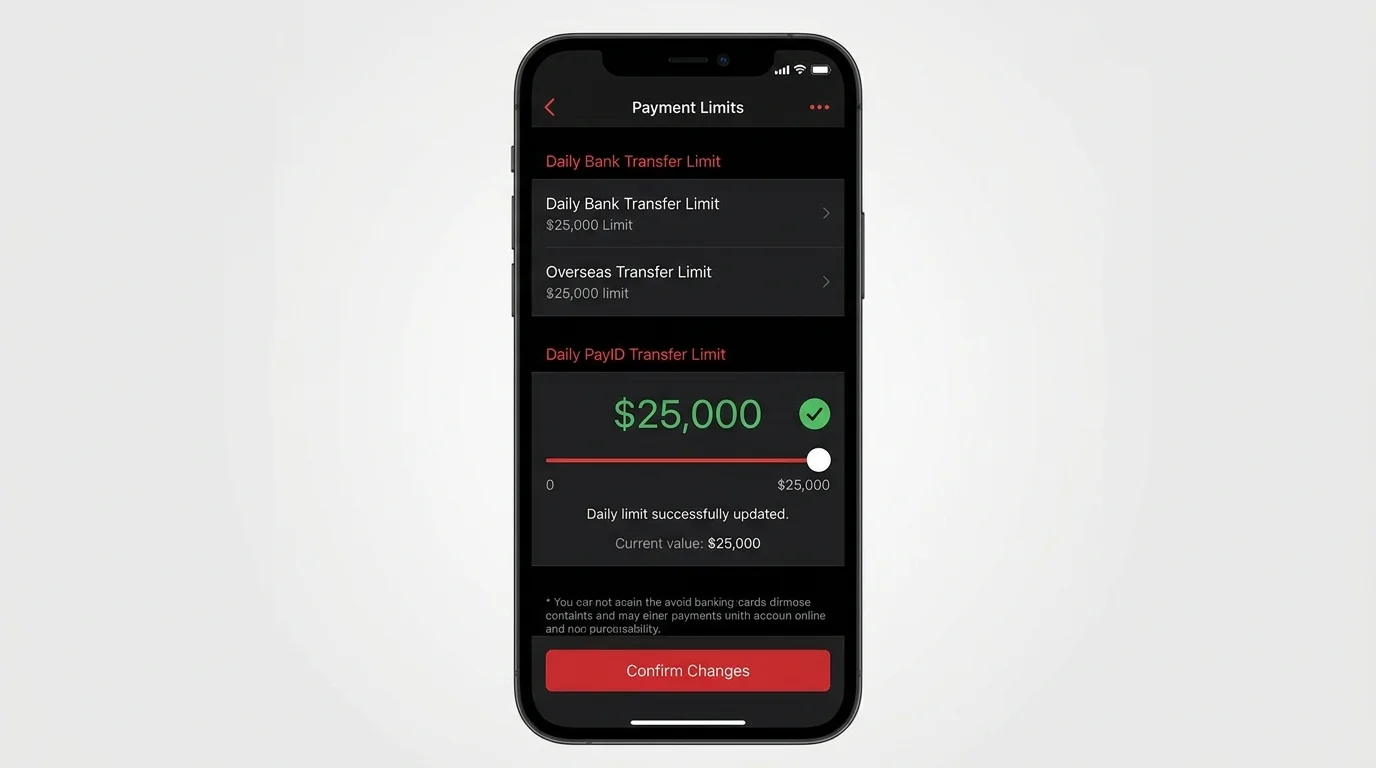
To raise the limit, open the NAB app, tap your profile icon, and navigate to Daily Limits. The flow asks for the new limit, sends a verification code or app push, and applies the change once you confirm. NAB’s confirmation step is slightly more conservative than the other Big Four — the bank sometimes requires a 15 to 60 minute delay between requesting a limit raise and the new limit becoming active. This delay is intentional and is part of the fraud team’s window for reviewing limit-change requests that might indicate scam victim behaviour.
Higher limits than A$25,000 per day need a phone call. NAB’s customer service line can authorise temporary lifts up to A$100,000 for named transactions, with the lift applying to that specific transfer only. The standing limit returns to whatever it was set at after the transfer clears.
The limit reset cycle is midnight Sydney time. A NAB customer who needs to move A$50,000 in a single day will need to either phone in for a one-off lift or split the amount across two days at A$25,000 each, sending one tranche before midnight and the other immediately after.
NAB’s Gambling Block is the bank’s harm-reduction tool, structured the same way as the equivalents at CommBank and Westpac. It blocks card transactions to merchants tagged with the gambling MCC (7995) and applies to both onshore and most offshore card-funded gambling.
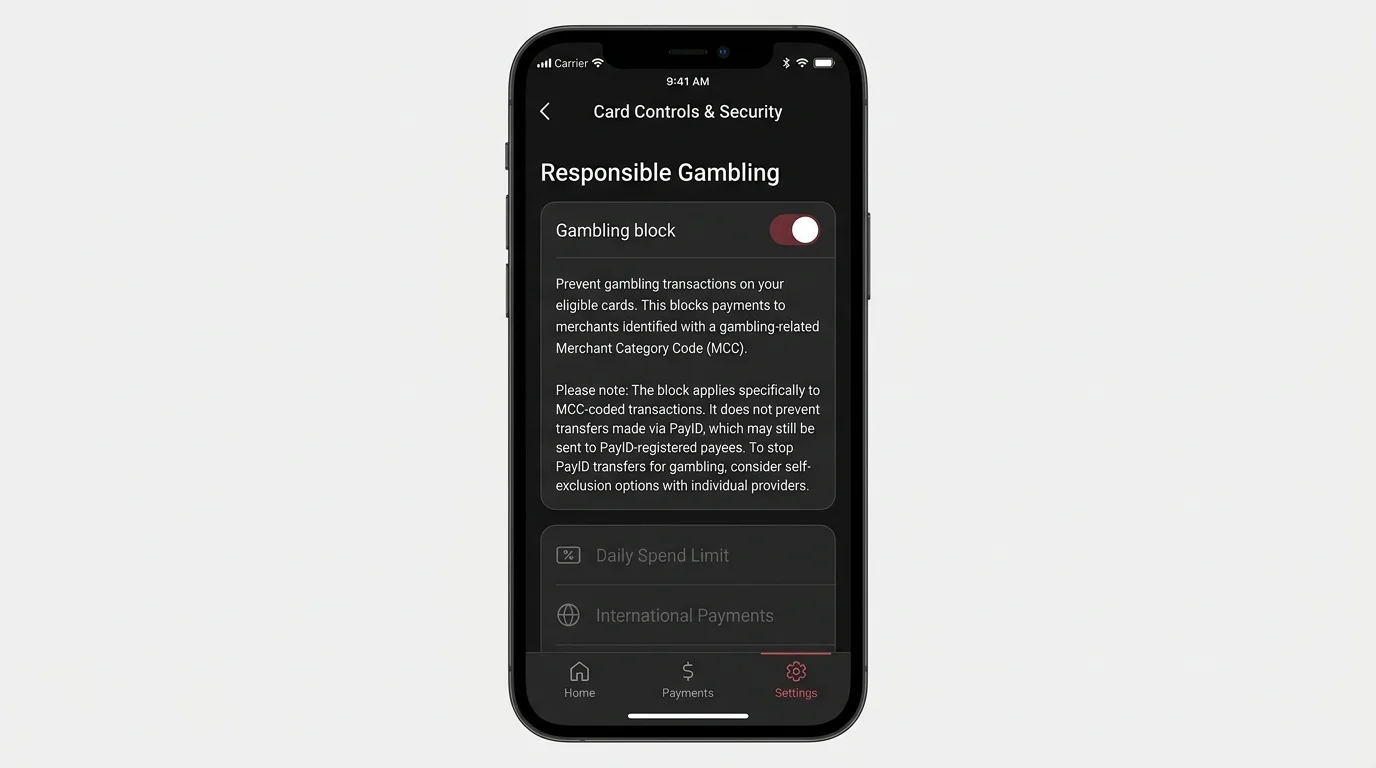
The PayID gap is identical to the gap at every other Big Four bank: the block operates on merchant category codes attached to card transactions, and PayID transfers do not carry an MCC because they run through the NPP as account-to-account transfers. The block cannot identify a PayID recipient as a gambling merchant because the rail simply does not carry that information. NAB documents this limitation in the Gambling Block product information page, which is more transparency than some competitors offer.
The mitigation is the same as at every Big Four bank: BetStop registration is the layer that closes the PayID gap, because BetStop operates at the operator level rather than the merchant level. A player who registers with BetStop and also enables NAB Gambling Block has two complementary tools running together — the bank-side block catches card-based onshore gambling, BetStop catches operator-level interaction. Players who only enable Gambling Block and continue to deposit at offshore casinos via PayID are observing the structural limit of the tool. For ANZ customers, the picture is similar but with slightly different default limits — the ANZ banking flow for PayID casino deposits piece covers ANZ’s specifics.
This is where NAB diverges most visibly from the other Big Four. The Fintel Alliance’s intelligence sharing arrangement gives NAB’s fraud team access to AUSTRAC-level transaction signals — AUSTRAC has analysed over 50 million cash transaction reports from the Big Four banks as part of its scam-detection work — and that data flows into NAB’s outbound transfer fraud model.
Paul Jevtovic, who led NAB’s financial crime function, has described the partnership openly: the bank’s role in Fintel Alliance is to feed transaction-level signals into a shared pool that informs sector-wide scam detection. The operational consequence for retail customers is that NAB sees patterns in outbound transfers — including PayID transfers to new offshore-linked aliases — that other banks see later or not at all.
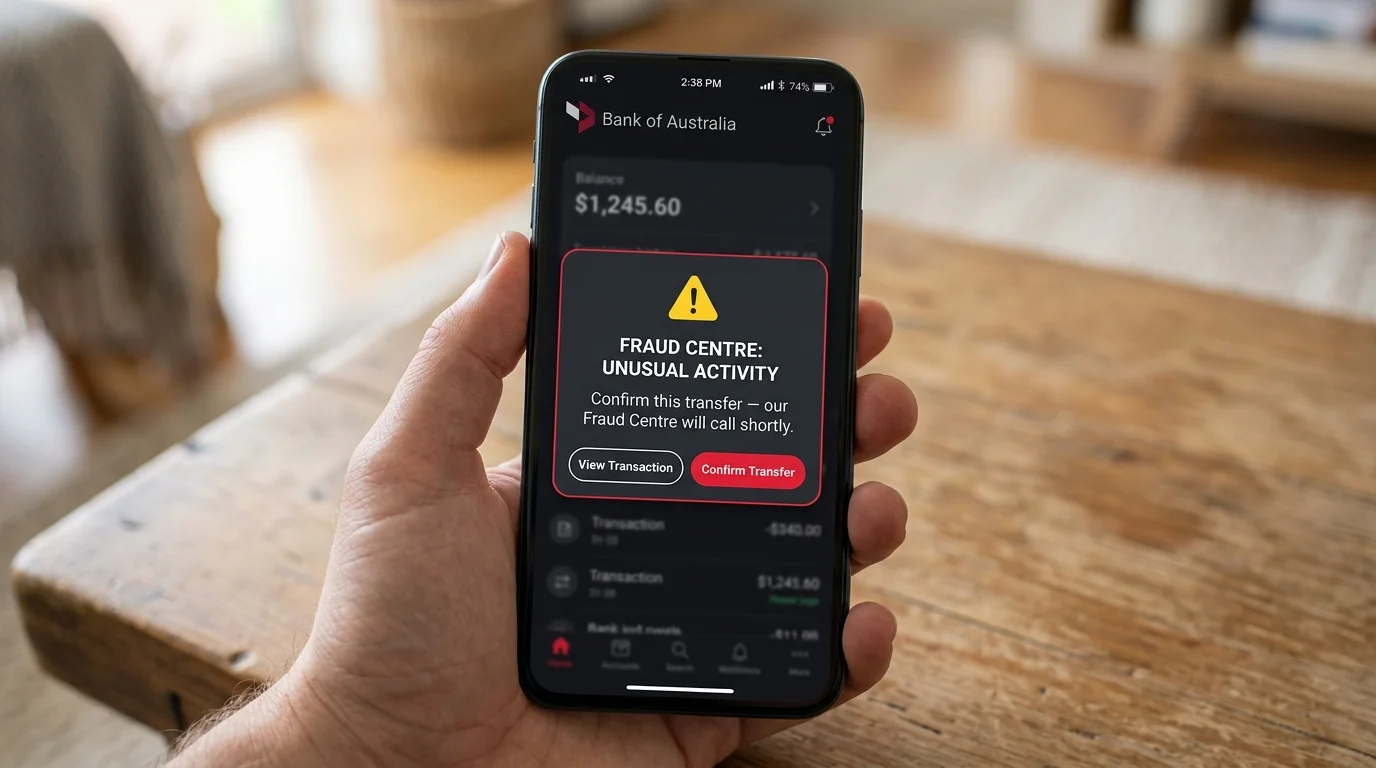
What this looks like in practice: a NAB customer initiates a first PayID transfer to an offshore casino’s alias. The transfer pauses on a “reviewing” screen. The fraud engine checks the alias against the Fintel-shared pool, looks at the customer’s account history, and either clears the transfer, escalates to a fraud-team manual review, or holds it pending an outbound phone call. The hold window is typically 2 to 24 hours, with most clears happening within 6 hours during business days and 12 to 18 hours overnight or on weekends.
The phone call, when it happens, is similar to CommBank’s but more detailed. The agent asks about the recipient, the purpose of the transfer, whether you have been in contact with anyone instructing you to send money, and whether you have verified the recipient’s identity. The questions sound intrusive but they are scripted scam-detection prompts. Honest answers release the hold within minutes. The release also typically removes future holds on transfers to the same alias — the second deposit usually clears without a pause.
First, the first-transfer hold. Around 60 per cent of NAB-originated casino PayID issues come from customers who initiated a first transfer and did not realise the bank’s review process would take hours rather than minutes. The fix is to allow the time and check the app for the fraud-team call or in-app prompt.

Second, daily limit overruns. NAB customers at the A$5,000 default limit who try to send larger amounts will see the transfer fail or partial-fill. Raise the limit in-app before attempting the transfer, accounting for NAB’s 15 to 60 minute delay on limit changes.
Third, name mismatch between the NAB account and the casino account. The same diagnostic and fix applies as at every other Big Four bank: ensure the legal name on both ends matches exactly before depositing.
Fourth, less common but more frustrating, NAB occasionally flags casino aliases on the Fintel-shared blacklist and refuses outbound transfers entirely. This is rare — typically reserved for operators with documented enforcement actions against them — but when it happens the only resolution is to use a different operator.
NAB is the most cautious of the Big Four on first transfers, the equal-fastest on repeat transfers, and the most rigorous on fraud detection. The trade-off is straightforward: customers who value strong scam protection accept the first-transfer delay as the cost of the protection layer. Customers who want the fastest possible first deposit will find CommBank smoother. For the casino-bound NAB customer, the practical advice is to make the first deposit small (A$50 to A$200), expect a delay, and treat the hold time as a one-off rather than a recurring friction. From the second transfer onward, NAB performs identically to its Big Four peers.

Prepared by the casinopayidau.com editorial staff.